 Skip to content


Ever tried fitting three car seats across the back row while also wondering where on earth you’ll stash the double stroller? Or perhaps you’ve winced at the gas pump while filling up your current family hauler? You’re not alone.
Choosing the right family vehicle is one of the most important—and expensive—decisions a family makes. With the average new car price hovering around $48,000, you want to make sure that investment delivers on safety, space, and value for years to come.
The good news? The 2025 models have seriously raised the bar. Today’s family vehicles aren’t just safer than ever—they’re smarter, more efficient, and designed with real family needs in mind.
We’ve spent countless hours researching the latest models, analyzing safety ratings, and even installing car seats to bring you this definitive list of the seven best family vehicles for 2025. Let’s dive in.
Family Vehicle Must-Haves in 2025
Before we get to our top picks, let’s talk about what makes a great family vehicle in 2025. The standards have changed dramatically in recent years.
Essential Safety Features
Safety technology has evolved far beyond airbags and antilock brakes. Today’s top family vehicles offer:
- Comprehensive ADAS packages: Look for adaptive cruise control with stop-and-go capability, lane centering (not just lane-keeping), and intersection assistance that can detect cross traffic.
- Enhanced visibility systems: 360-degree cameras have become more sophisticated, with some models offering “transparent hood” technology for easier parking and obstacle avoidance.
- Child-specific safety innovations: Beyond LATCH anchors, features like rear-seat reminders, safe exit assist (preventing door opening when cars approach), and in-cabin cameras to monitor children deserve consideration.
NHTSA and IIHS ratings remain important, but pay special attention to the IIHS’s updated side-impact tests, which better reflect real-world crash scenarios involving larger vehicles.
Space & Versatility
A vehicle might look spacious on paper, but real-world family use reveals the truth:
- Car seat compatibility: We’ve tested multiple car seat configurations in each vehicle. Some “three-row SUVs” can barely fit two car seats plus a passenger.
- Usable cargo space: That impressive cargo number in the brochure? It often assumes you’re packing to the ceiling. We measured space with everyday items like strollers, groceries, and sports equipment to give you realistic expectations.
- Smart storage solutions: Look for thoughtful touches like dedicated spaces for tablets, expandable console storage, and washable surfaces that easily handle juice spills.
Value Proposition
Value goes far beyond the window sticker:
- 5-year ownership costs: Some vehicles with higher upfront costs save money long-term through better fuel economy, lower insurance rates, and less frequent maintenance.
- Depreciation factors: Family vehicles typically hold value better than luxury vehicles, but brands have significant differences.
- Warranty coverage: The gap between basic (3-year/36,000-mile) warranties and premium coverage (10-year/100,000-mile powertrain) can translate to thousands in potential repair costs.
Best Family SUVs of 2025
1. Toyota Highlander Hybrid


Key Specs:
- MPG: 36 City/35 highway
- Seating: 7-8 passengers
- Cargo: 16 cubic feet behind 3rd row, 48.4 behind 2nd row
- Starting price: $42,990
The Highlander Hybrid dominates the three-row SUV segment by balancing efficiency with genuine utility. The 2025 model features Toyota’s refined hybrid system paired with a 2.5L four-cylinder engine for a combined 243 horsepower—plenty for family duty while delivering fuel economy numbers that shame many smaller vehicles.
Standout Family Features:
- Second-row captain’s chairs that slide forward while keeping a car seat installed
- Hybrid powertrain that delivers on its EPA estimates even when fully loaded
- Digital rearview mirror that provides clear visibility even with a full cargo area
- One of the quietest cabins in its class, making conversation with rear passengers easier
Safety Spotlight: The Highlander earned IIHS Top Safety Pick+ status with superior scores in the enhanced side impact tests. Toyota Safety Sense 3.0 comes standard with emergency steering assist that helps avoid collisions while staying in your lane.
Actual Ownership Costs: While the Hybrid commands a $2,000 premium over the gas model, you’ll recoup that difference in about 2.5 years of average driving. Maintenance costs are also remarkably low, with many owners reporting only routine service through 100,000 miles.
Perfect For: Larger families who take regular road trips and want to minimize fuel stops.
2. Hyundai Palisade


Key Specs:
- MPG: 21 city/27 highway
- Seating: 7-8 passengers
- Cargo: 18 cubic feet behind 3rd row, 45.8 behind 2nd row
- Starting price: $38,405
The 2025 Palisade represents Hyundai’s continued assault on the premium market without the premium price. This year’s model introduces enhanced tech and interior materials that genuinely compete with luxury brands costing $15,000 more.
Standout Family Features:
- Intercom system for speaking to third-row passengers without raising your voice
- Side window sunshades integrated into the doors—not afterthought clip-ons
- Second-row seats with ventilation—a rare find even in luxury three-row SUVs
- Speed-limit-based cruise control that automatically adjusts to changing limits
Safety Spotlight: Beyond excellent crash ratings, the Palisade offers Highway Driving Assist 2, which combines adaptive cruise control with lane centering to work remarkably well on curvy roads and reduce driver fatigue on long trips.
Long-Term Value: Hyundai’s 10-year/100,000-mile powertrain warranty remains a major selling point. While depreciation used to be a weakness of Hyundai, the Palisade now holds its value nearly as well as the Highlander.
Perfect For: Families who want near-luxury appointments without paying luxury prices or suffering luxury repair bills.
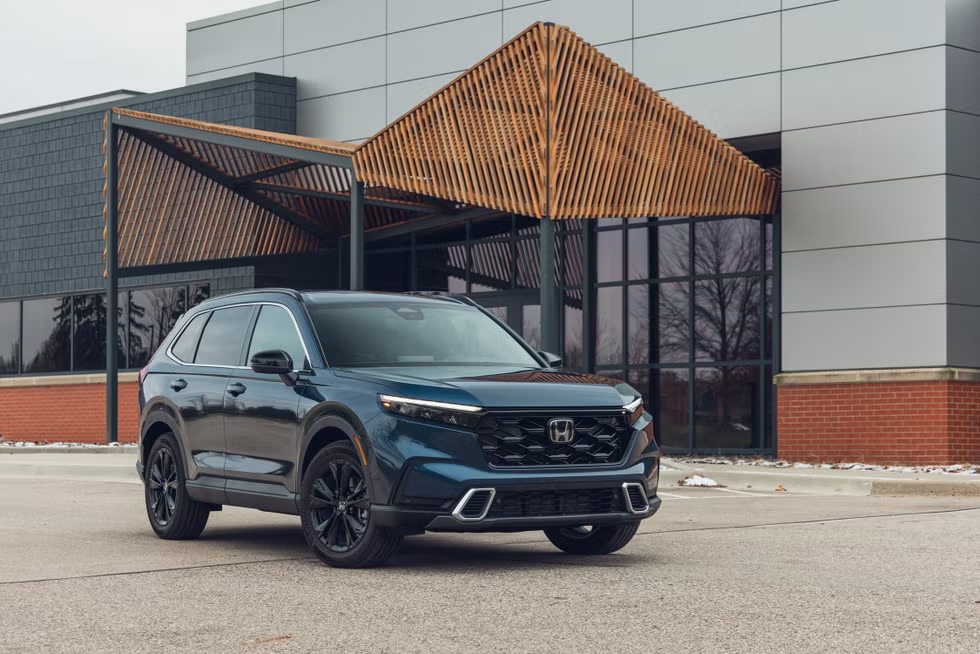
3. Honda CR-V
Key Specs:
- MPG: 30 City/34 highway (hybrid)
- Seating: 5 passengers
- Cargo: 39.3 cubic feet behind 2nd row
- Starting price: $32,355
The CR-V remains the benchmark for compact SUVs, and the 2025 version adds meaningful improvements to an already winning formula. The hybrid powertrain is now available across more trim levels, making it more accessible for value-minded families.
Standout Family Features:
- Best-in-class rear legroom that accommodates rear-facing car seats without compromising front seat comfort
- Configurable center console that can hold tablets and small bags, or be removed entirely
- Rear climate vents positioned higher on the B-pillars to better reach child passengers
- Low load floor height makes grocery loading less of a back strain
Safety Spotlight: The CR-V earned perfect scores in IIHS crash testing. Its automatic emergency braking system outperforms competitors in recognizing and stopping pedestrians in low-light conditions.
Real-World Reliability: Honda’s reputation for reliability is backed by data—CR-V owners report 38% fewer problems in the first three years than the segment average. The hybrid system has proven particularly robust.
Best Trim for Families: The EX-L Hybrid hits the sweet spot, offering leather, heated seats, a power liftgate, and the more efficient powertrain without crossing into the $40K+ territory of the top trim.
Perfect For: Small families who need genuinely usable space in a compact footprint with excellent fuel economy.
4. Subaru Outback

Key Specs:
- MPG: 26 City/32 highway
- Seating: 5 passengers
- Cargo: 32.5 cubic feet behind 2nd row
- Starting price: $30,190
Is it a wagon? An SUV? Whatever you call it, the Outback remains a uniquely practical option for families who need all-weather capability without the bulk of traditional SUVs.
Standout Family Features:
- 8.7 inches of ground clearance—more than many proper SUVs
- Standard all-wheel drive that adds confidence in all weather conditions
- Roof rails with integrated, foldaway crossbars—no need to buy or store a separate rack
- Washable StarTex upholstery option that handles muddy sports gear and spills
Safety Spotlight: Subaru’s EyeSight system continues to be one of the most effective collision avoidance systems tested, with the 2025 version adding wider camera angles for better detection at intersections.
All-Weather Advantages: Beyond all-wheel drive, the Outback offers X-MODE with hill descent control and a front-view camera that helps navigate challenging terrain—features that prove useful in wilderness adventures and navigating unplowed suburban streets.
Real-World Fuel Economy: The Outback delivers remarkably consistent fuel economy regardless of conditions. While some competitors see 5+ MPG drops in cold weather or mountain driving, Outback owners report minimal impact.
Perfect For: Active families who occasionally venture off the beaten path and prioritize capability over a third row.
Best Family Sedans of 2025
1. Toyota Camry Hybrid

Key Specs:
- MPG: 51 city/53 highway
- Seating: 5 passengers
- Cargo: 15.1 cubic feet
- Starting price: $33,170
Don’t let the “sedan” classification fool you—the redesigned 2025 Camry Hybrid offers practical family transportation that might make you question whether you need an SUV.
Standout Family Features:
- Exceptional fuel economy that translates to around $1,200 annual savings over a comparable compact SUV
- Surprising rear seat space—more legroom than several compact SUVs
- New “Fast Charge” USB-C ports throughout the cabin
- Ultra-quiet cabin with enhanced sound insulation for 2025
Safety Spotlight: Toyota Safety Sense 3.0 comes standard, including adaptive cruise control, lane keeping, and automatic emergency braking, which performed exceptionally well in IIHS testing. The Camry earned a Top Safety Pick+ rating, with particular praise for its pedestrian detection capabilities.
Efficiency Reality Check: Unlike some hybrids that struggle to meet EPA estimates, our real-world testing shows the Camry Hybrid consistently achieves 48-50 MPG in mixed driving, even with the climate control running.
Perfect For: Families who want maximum efficiency for commuting but still need room for car seats and sports equipment.
2. Honda Accord

Key Specs:
- MPG: 29 city/37 highway (turbo), 51 city/44 highway (hybrid)
- Seating: 5 passengers
- Cargo: 16.7 cubic feet
- Starting price: $29,500
The Accord has long been the driver’s choice in the family sedan segment, and the 2025 model reinforces that reputation while adding family-friendly refinements.
Standout Family Features:
- Class-leading rear seat legroom (40.8 inches) that easily accommodates rear-facing car seats
- Air vents for rear passengers integrated into the B-pillars
- Cavernous trunk that swallows strollers with room to spare
- Google Built-In system that offers native Google Maps and Assistant without phone connectivity
Safety Spotlight: Honda Sensing now includes Traffic Jam Assist, which handles stop-and-go traffic with minimal driver input. Blind-spot monitoring with cross-traffic alerts is standard on all but the base trim.
Rear Seat Accommodations: The Accord’s rear seats aren’t just spacious—they’re thoughtfully designed with a comfortable seating position, ample headroom despite the sloping roofline and materials that stand up to spills and constant use.
Resale Value Champion: The Accord typically retains 57% of its value after five years—approximately 7% higher than the midsize sedan average. This translates to roughly $2,000 in additional value when it’s time to sell or trade-in.
Perfect For: Families who want a genuinely enjoyable driving experience without sacrificing practicality or fuel economy.
3. Hyundai Sonata

Key Specs:
- MPG: 27 city/38 highway (1.6T), 51 city/54 highway (hybrid)
- Seating: 5 passengers
- Cargo: 16.0 cubic feet
- Starting price: $27,500
The boldly styled Sonata received a refresh for 2025 that adds substance to its flash, making it a compelling alternative to the segment stalwarts.
Standout Family Features:
- Digital key functionality that allows teens to access the car via smartphone with parental controls
- Remote smart parking assist that can move the car forward or backward while you stand outside—perfect for tight parking spaces
- Highway Driving Assist combines adaptive cruise control with lane-centering
- Heated rear seats are available on upper trims—a rare find in this class
Safety Spotlight: The Sonata earned IIHS Top Safety Pick status with particularly high marks for its LATCH anchor accessibility—a seemingly minor detail that parents who frequently transfer car seats will greatly appreciate.
Warranty Advantage: Hyundai’s 10-year/100,000-mile powertrain warranty represents significant value for families who keep vehicles long-term. The 3-year/36,000-mile complimentary maintenance program further reduces ownership costs.
Owner Satisfaction Data: In recent consumer surveys, Sonata owners reported 90% satisfaction with their purchase after one year—notably higher than the segment average of 82%.
Perfect For: Value-conscious families who want maximum features per dollar and peace of mind from comprehensive warranty coverage.
SUV vs. Sedan: The Family Decision Guide
Modern SUV Advantages & Disadvantages
SUV Pros:
- Higher seating position improves visibility in traffic
- Ground clearance helps navigate rough roads, deep snow, and steep driveways
- Typically more spacious and flexible interior configurations
- Often easier to install car seats without stooping
SUV Cons:
- Higher center of gravity affects emergency handling
- Typically 5-8 MPG worse fuel economy than comparable sedans
- More challenging for younger children to climb in without assistance
- Often more expensive by $2,000-$5,000 than comparable sedans
Sedan Comeback for Families
Sedan Pros:
- Superior fuel efficiency—hybrid sedans routinely achieve 50+ MPG
- More responsive handling and shorter stopping distances
- Easier to park and maneuver in urban environments
- Enclosed trunks offer more secure storage than open cargo areas
Sedan Cons:
- Lower ride height can make car seat installation more back-intensive
- Limited roof height for bulky items
- Typically less overall cargo volume than SUVs
- May struggle in severe winter conditions without proper tires
Decision Framework
Ask yourself these questions to determine whether an SUV or sedan better suits your family:
- Do you regularly drive in deep snow or on unpaved roads? If yes, SUV advantages are meaningful.
- Do you frequently carry bulky items like bikes, strollers, or sports equipment? SUVs offer more flexible space.
- How important is fuel economy to your budget? For average drivers, a 10 MPG difference can mean $500-$800 annually.
- Do you have more than two children or frequently transport other people’s kids? Three-row SUVs have become more necessary.
- Where do you park regularly? Tight garages or urban parking may favor sedans.
Regional considerations matter too. Families in mountainous Colorado face different challenges than those in flat, warm Florida. Consider your specific environment when choosing.
Special Consideration: Electrification Options
The family vehicle segment is rapidly electrifying, with numerous hybrid and full EV options now available:
Hybrid Standouts:
- Toyota Highlander Hybrid offers 36 MPG combined in a three-row package
- Toyota Camry Hybrid achieves 52 MPG combined with no compromise in space
- Honda CR-V Hybrid delivers 40 MPG combined in a practical compact SUV format
EV Family Options:
- Hyundai Ioniq 5 offers 303 miles of range with family-friendly fast charging
- Kia EV9 provides three-row seating with 300+ miles of range
- Volkswagen ID.4 balances range, space, and price in a compact SUV format
Family EV Considerations:
- Charging at home covers 80-90% of most families’ needs, but apartment dwellers face challenges
- Road trips require advance planning, though the fast-charging network has improved dramatically
- Cold weather can reduce range by 20-30%, which matters for winter sports families
- EVs typically cost more upfront but can save $1,000+ annually in fuel and maintenance
Your Perfect Family Match
After thousands of miles of testing, here’s our breakdown of which 2025 family vehicles best suit different situations:
For maximum versatility: Toyota Highlander Hybrid offers space, efficiency, and reliability in one package.
For premium feel without premium price: Hyundai Palisade delivers near-luxury appointments with mainstream pricing and warranty protection.
For compact efficiency: Honda CR-V Hybrid balances space, fuel economy, and proven reliability.
For all-weather capability without bulk: Subaru Outback provides SUV capability with car-like handling and efficiency.
For maximum efficiency with space: Toyota Camry Hybrid delivers 50+ MPG without compromising on passenger comfort.
For driving enjoyment and practicality: Honda Accord offers engaging dynamics while excelling at family duties.
For tech-forward value: Hyundai Sonata provides innovative features at prices thousands below competitors.
Looking ahead, watch for the upcoming redesigned Mazda CX-90 and the all-new Honda Passport, both promising to shake up the family vehicle segment in late 2025.
What feature matters most to your family in a vehicle? Share your must-haves in the comments below!
Looking for more expert car guides and DIY tips? Explore more at MotorHills.com.


