 Skip to content

Yes, hybrid trucks are worth it in 2026. But only when the truck actually fits the job.
That sounds obvious, but it is where a lot of shoppers get pulled in the wrong direction. The Ford Maverick Hybrid, Toyota Tacoma i-FORCE MAX, and Ford F-150 PowerBoost all wear the hybrid label, but they are not chasing the same buyer.
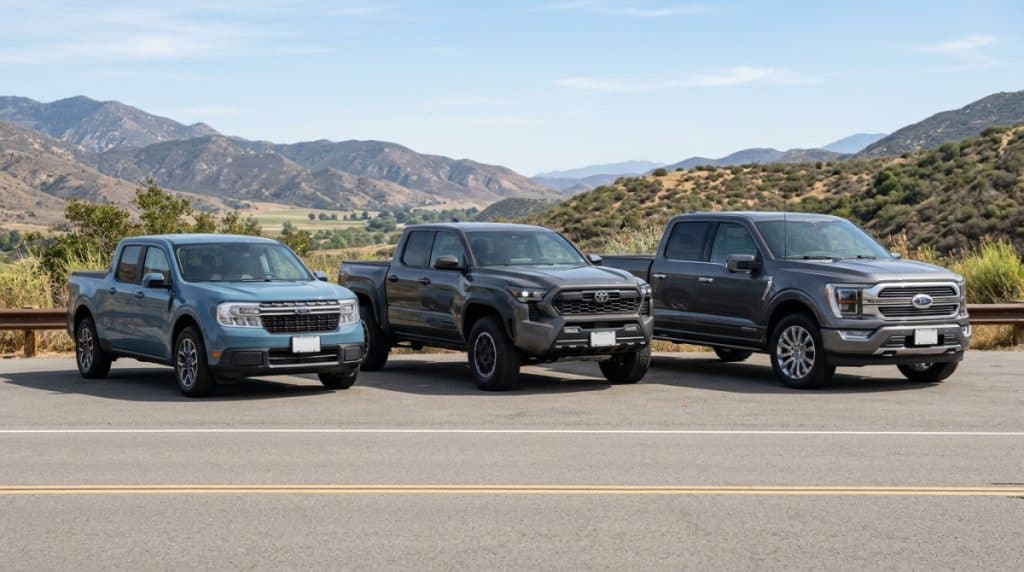
The Maverick is the fuel-sipping small truck. The Tacoma Hybrid is the midsize torque play. The F-150 PowerBoost is the full-size truck for people who tow, haul, work, camp, or want power from the truck itself.
So the real question is not just, “Are hybrid trucks worth it?”
It is, “Which one actually makes sense for the way I drive?”
Quick Comparison: Maverick Hybrid vs Tacoma Hybrid vs F-150 PowerBoost
| Truck | Price Bracket | MPG | Max Towing | Max Payload | Best Buyer |
|---|---|---|---|---|---|
| Ford Maverick Hybrid | High $20,000s to Upper $30,000s | Up to 42 city / 35 highway / 38 combined with FWD, or 40 city / 34 highway / 37 combined with AWD | 2,000 lbs standard, up to 4,000 lbs with available 4K Tow Package and AWD | Up to 1,500 lbs, depending on setup | Commuters, homeowners, light truck users |
| Toyota Tacoma i-FORCE MAX | Upper $40,000s to Mid $60,000s | About 23 combined | Up to 6,000 lbs, depending on trim and setup | Varies by configuration | Midsize truck buyers, 4WD users, off-roaders |
| Ford F-150 PowerBoost | Low $50,000s and up | About 23 combined in some 4×4 examples | Up to 12,400 lbs for PowerBoost, depending on configuration | Up to around 1,740 lbs | Towing, work, road trips, onboard power |
The Maverick is the easiest one to like if mpg and price matter most. The Tacoma makes more sense when you want a stronger midsize truck with off-road confidence. The F-150 PowerBoost is for the buyer who needs a truck to do real truck things.
That is why this is not a normal three-way shootout. These trucks are in different size classes, and that changes the answer right away.
Why This Comparison Is Trickier Than It Looks
The Maverick is the small one here. Ford lists the 2026 Maverick with a standard 2,000-pound towing capacity, with up to 4,000 pounds available when properly equipped with the 4K Tow Package and AWD. The hybrid also comes with FWD or available AWD.
That makes the Maverick feel less like an old-school truck and more like a small SUV with a useful bed. For a lot of drivers, that is exactly the appeal. It is easy to park, easier on fuel, and still useful when you need to haul something awkward.
The Tacoma sits in the middle. Toyota says the 2026 Tacoma i-FORCE MAX makes up to 326 horsepower and 465 lb-ft of torque, with an EPA-estimated 23 mpg combined rating.
That tells you what Toyota is doing here. The Tacoma Hybrid is not trying to be a Maverick-style fuel saver. It is trying to feel stronger, especially for buyers who want 4WD, trail use, camping gear, and a more traditional midsize truck feel.
Then there is the F-150 PowerBoost. Ford’s 2026 F-150 towing guide lists the 3.5L PowerBoost Full Hybrid V6 at 420 horsepower and 570 lb-ft of torque. Depending on configuration, the PowerBoost can tow up to 12,400 pounds, while the broader F-150 lineup reaches up to 13,500 pounds with the 3.5L EcoBoost V6.
That is a completely different conversation. If you need full-size capability, the Maverick’s great mpg will not help much. If you mostly commute and make the occasional hardware store run, the F-150 may be more truck than you need.
So yes, the Maverick wins fuel economy. But “best mpg” and “best truck for you” are not always the same answer.
Why Hybrid Trucks Make Sense Right Now
Hybrid trucks make sense because they do not ask you to change your whole routine.
You still go to the gas station. You do not need a home charger. You do not have to plan every trip around charging stops. The electric side helps, but the truck still lives like a normal gas vehicle.
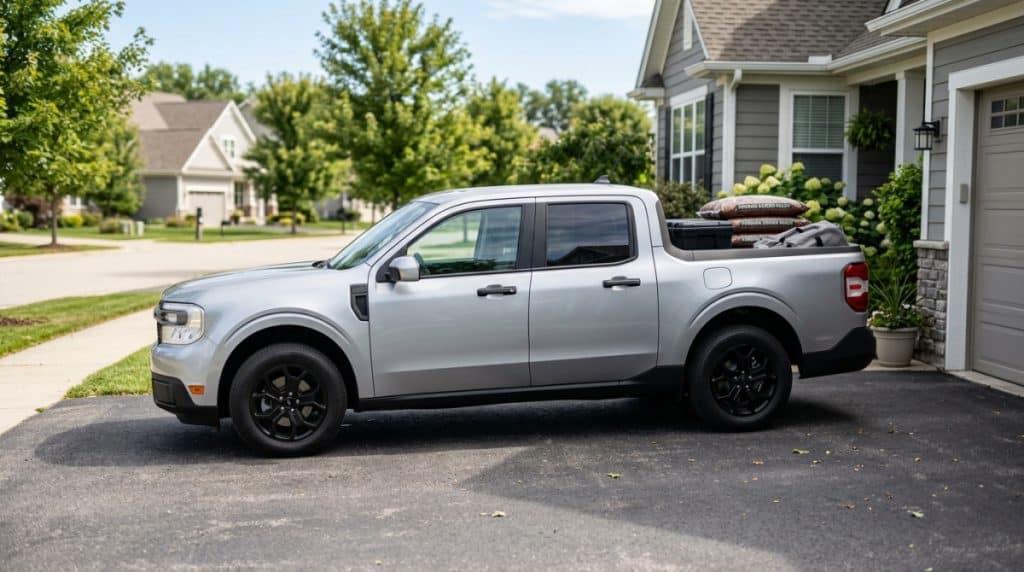
That middle ground matters. Pew Research Center reported in April 2026 that 44% of Americans said they would seriously consider buying a hybrid vehicle, compared with 32% who said the same about an EV.
That feels pretty realistic for truck shoppers. A lot of people want better fuel economy, but they are not ready for a full EV truck. Maybe they tow. Maybe they road-trip. Maybe they park outside. Maybe they just do not want another thing to manage.
A hybrid truck can be a practical middle step. But the badge alone does not make it smart. The price, size, towing rating, fuel savings, and your actual driving habits still matter.
If you are still comparing electrified options in general, our breakdown of electric vs hybrid cars is a good place to start.
Ford Maverick Hybrid: The Smart Daily Driver Pick
The Maverick Hybrid is probably the easiest truck here to recommend to everyday drivers.
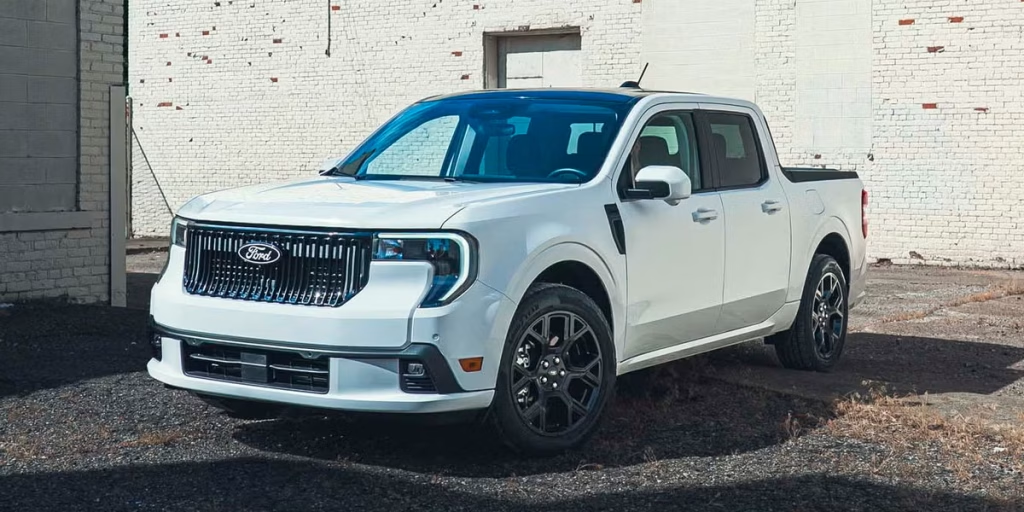
Not everyone needs a huge pickup. Sometimes you just want something that can handle commuting, errands, a hardware store run, a few bags of mulch, a bike, some tools, or a small trailer. That is where the Maverick feels honest.
If you are still deciding whether you need a pickup at all, our guide on truck vs SUV: which is right for you can help you sort that out before you spend truck money.
Ford lists the 2026 Maverick Hybrid at up to 42 city, 35 highway, and 38 combined mpg in FWD form. If you choose the AWD hybrid, the rating drops slightly to 40 city, 34 highway, and 37 combined mpg.
That is still strong fuel economy for a small truck. Just remember that the best mpg number belongs to the FWD hybrid, not every Maverick Hybrid configuration.
The towing number also needs a careful read.
A Maverick Hybrid does not automatically tow 4,000 pounds. Standard towing is 2,000 pounds. The higher 4,000-pound rating requires the available 4K Tow Package and AWD.
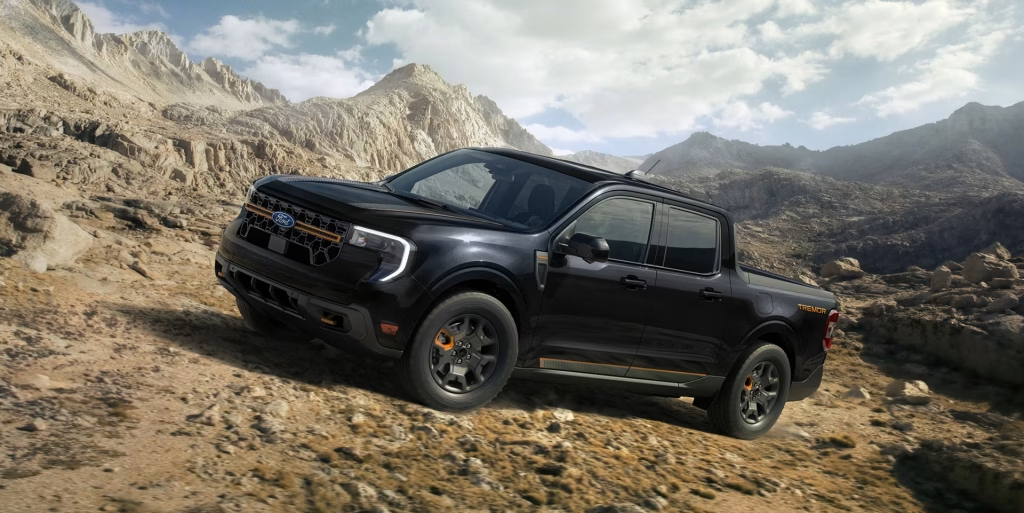
That distinction matters. Someone shopping quickly could see “4,000 pounds” and assume every Maverick Hybrid can do it. It cannot.
For most light-duty buyers, though, the Maverick still has plenty of usefulness. Small trailer? Weekend project supplies? Bikes? Furniture? Yard stuff? That is the kind of work this truck was made for.
It also has some outside validation. The Ford Maverick Lobo was named the 2026 North American Truck of the Year. That award is not specifically for the Maverick Hybrid, so it should not be treated like a direct hybrid endorsement. Still, it shows the Maverick platform is being taken seriously.
The Maverick Hybrid is the one to start with if you want truck utility without making every fuel stop, parking space, and monthly payment feel bigger than it needs to be.
Toyota Tacoma i-FORCE MAX: Torque First, Fuel Savings Second
The Tacoma Hybrid is the one that needs the clearest expectation check.
If you are expecting huge hybrid fuel savings, this probably is not the truck you have in mind. Toyota lists the 2026 Tacoma i-FORCE MAX at about 23 mpg combined. That is fine for a midsize truck with this much torque, but it is not the same story as the Maverick.
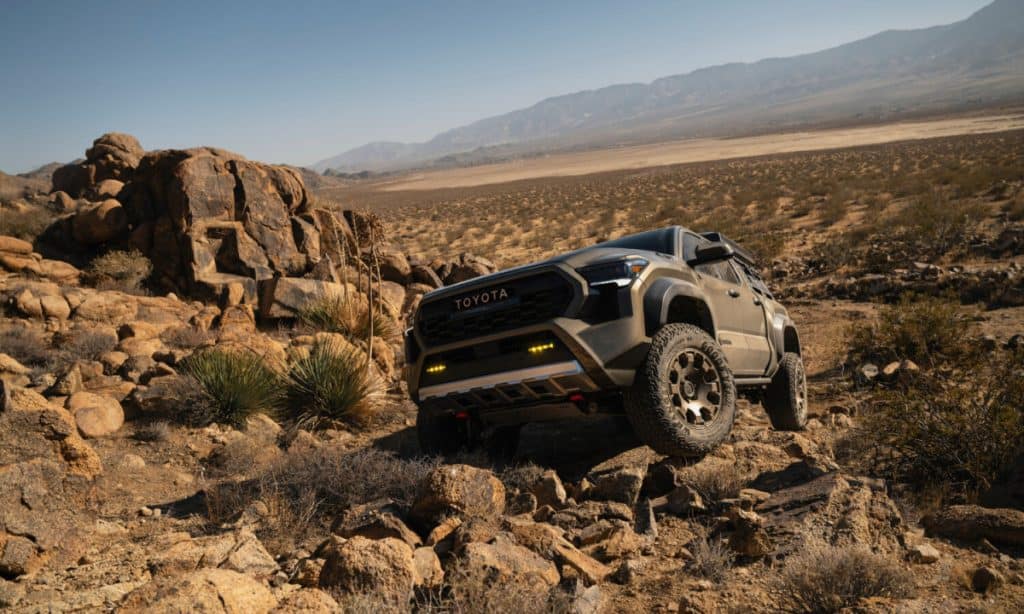
The Tacoma Hybrid is really about power delivery.
Toyota says the i-FORCE MAX makes up to 326 horsepower and 465 lb-ft of torque. That torque is the reason this truck makes sense. It helps with passing, climbing, towing, carrying gear, and slow-speed trail driving.
This is the truck for someone who looks at the Maverick and thinks, “Nice, but I need something tougher.”
That does not mean everyone should jump to the Tacoma. The price is the hard part. The Tacoma i-FORCE MAX starts in the upper-$40,000s, and higher trims can climb into the mid-$60,000s. At that point, you are not shopping for a cheap way to save fuel anymore.
What helps the Tacoma case is ownership confidence. Toyota says every Toyota hybrid battery is covered by a 10-year or 150,000-mile limited warranty, whichever comes first. Toyota’s 2026 Tacoma Hybrid warranty guide also lists the hybrid battery warranty at 10 years or 150,000 miles.
That does not make the Tacoma Hybrid cheap. It just gives long-term buyers one less thing to worry about.
The Tacoma Hybrid makes the most sense when you want a midsize truck first and a hybrid second. If your main goal is saving gas, the Maverick is the cleaner answer.
Ford F-150 PowerBoost: The Workhorse Hybrid
The F-150 PowerBoost is the easiest one to understand when the truck actually has work to do.
This is not the hybrid you buy just to feel better at the pump. It is the hybrid you buy because you tow, haul, travel with gear, use tools away from home, or want your truck to double as a power source.
Ford’s 2026 F-150 towing guide lists the 3.5L PowerBoost Full Hybrid V6 at 420 horsepower and 570 lb-ft of torque. Depending on configuration, the PowerBoost can tow up to 12,400 pounds. Ford also lists the broader F-150 lineup at up to 13,500 pounds of towing when properly equipped with the 3.5L EcoBoost V6.
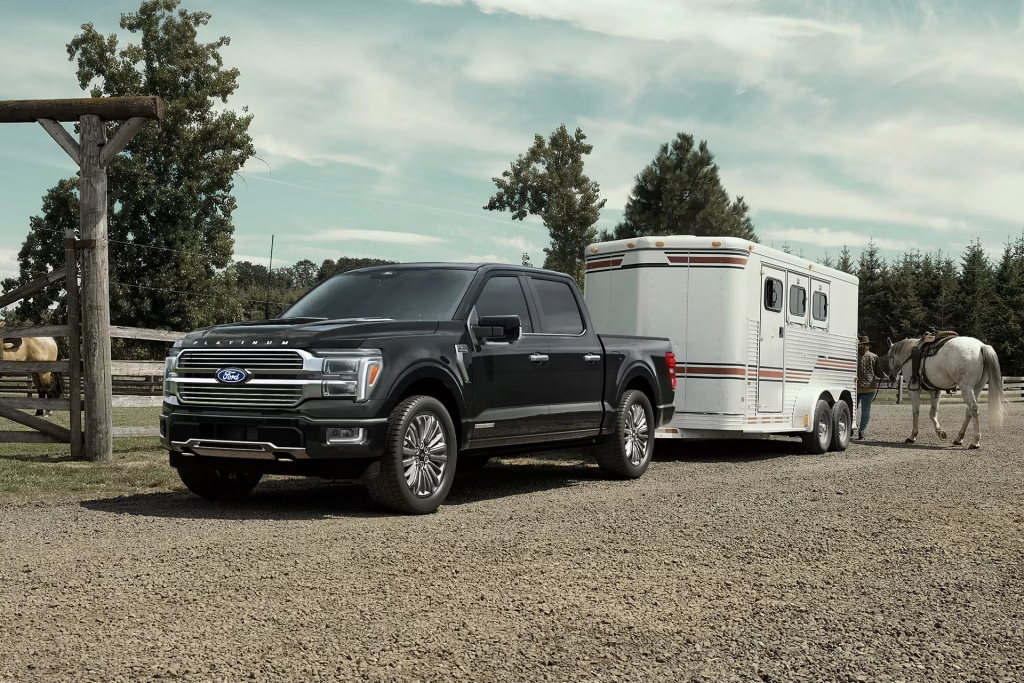
That puts the PowerBoost far beyond the Maverick and Tacoma in raw truck capability.
The PowerBoost also gets a big advantage from Pro Power Onboard. Ford’s towing guide notes that Pro Power Onboard is standard on PowerBoost. For the right buyer, that is not just a neat feature. It can mean running tools, lights, devices, or campsite equipment without bringing a separate generator.
Of course, there is a catch. The F-150 is big. It is expensive. It is not as easy to park as a Maverick. If your truck life is mostly commuting, groceries, and one furniture pickup every few months, this is probably too much truck.
But if towing, hauling, road trips, job-site use, or backup power are part of your routine, the F-150 PowerBoost has the strongest argument here.
Honorable Mention: What About the Ram 1500 eTorque?
The Ram 1500 eTorque belongs in the conversation, but not quite as a direct fourth truck.
Ram eTorque is a mild-hybrid system. It assists the gas engine, but it is not the same kind of full hybrid setup as the Maverick Hybrid, Tacoma i-FORCE MAX, or F-150 PowerBoost.
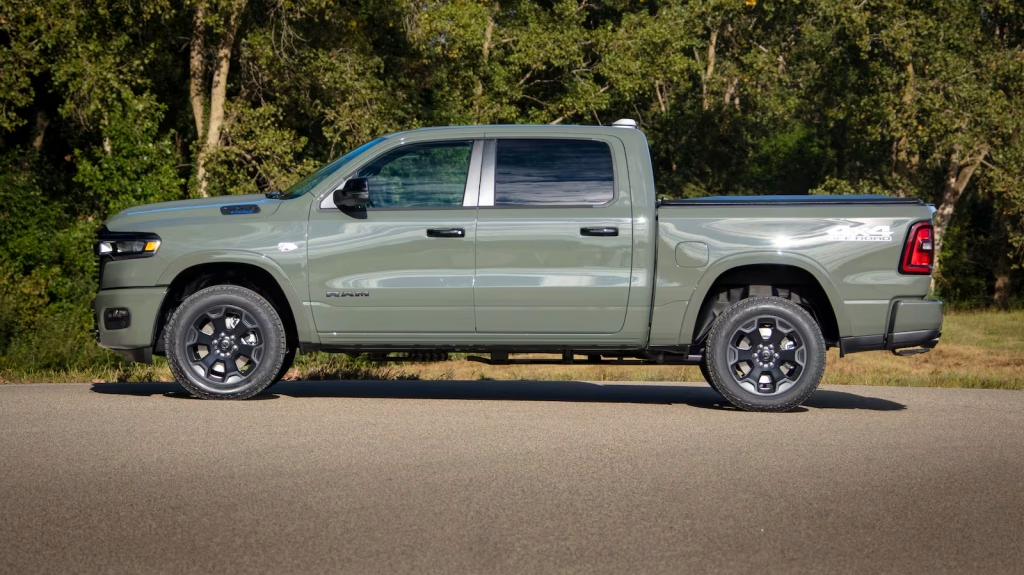
Ram lists the 2026 5.7L HEMI V8 with eTorque at 395 horsepower, 410 lb-ft of torque, up to 11,320 pounds of towing, and up to 1,650 pounds of payload.
Those are strong numbers. The Ram deserves to be cross-shopped if you are looking at full-size trucks. But for this specific article, it fits better as a side note because eTorque does not play the same role as Ford’s PowerBoost setup with major onboard power usefulness.
So yes, keep the Ram in mind. Just do not treat it like the same type of hybrid truck.
How to Tell If the Hybrid Premium Is Actually Worth It
It would be nice if there were one simple formula here, but there really is not.
A real cost-of-ownership answer depends on your local price, taxes, dealer pricing, gas prices, insurance, financing, annual mileage, incentives, and how long you keep the truck. Without those, any exact “you will save this much” claim would be shaky.
Still, you can judge it pretty well without building a full spreadsheet.
Start with the price gap. How much more does the hybrid cost compared with the closest gas version? If the difference is small, the hybrid has an easier job. If the difference is huge, fuel savings alone may not be enough.
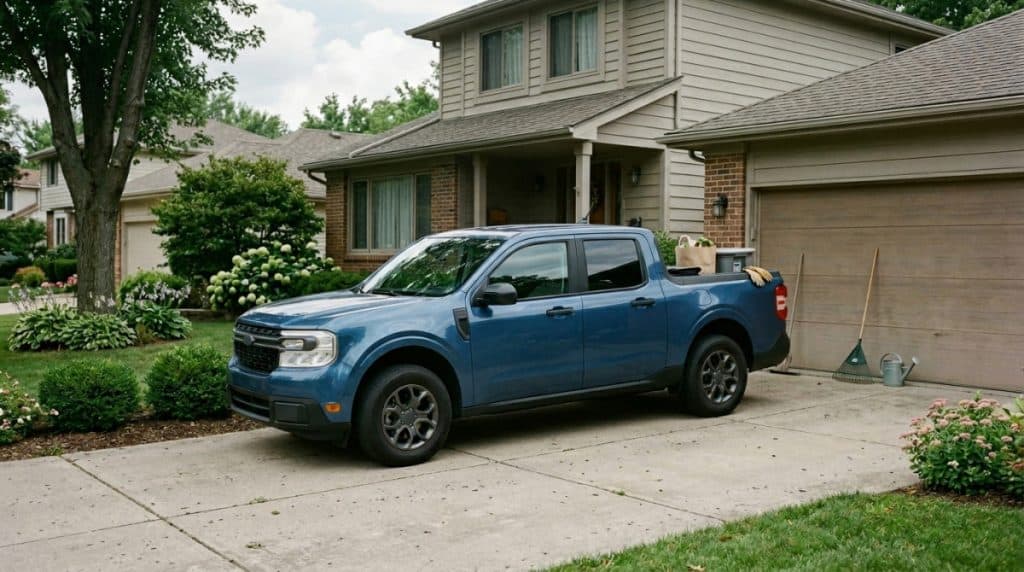
Then look at your mileage. Someone driving 15,000 miles a year has more room to benefit from better mpg than someone who mostly drives on weekends.
After that, ask what the hybrid system actually gives you.
With the Maverick, it is mostly fuel economy. With the Tacoma, it is torque. With the F-150 PowerBoost, it is towing strength, work utility, and onboard power.
And be honest about size. A bigger truck costs more in more ways than the sticker price. Fuel, tires, insurance, parking, payments, and general daily hassle can all go up.
That is why the cheapest truck that does the job is often the smartest truck.
Who Should Skip a Hybrid Truck?
Some people should skip the hybrid truck, and there is nothing wrong with that.
If the hybrid version pushes the payment too high, stop there. Better mpg does not fix a monthly payment that stresses you out.
You may also want to skip a hybrid truck if you barely drive, rarely haul anything, never tow, do not need extra torque, and will not use onboard power. At that point, a gas truck may do the same job for less money.
This is not about being pro-hybrid or anti-gas. MotorHills is not here to pick a team. We like cars, trucks, hybrids, EVs, gas engines, and anything else that actually makes sense for the person driving it.
The goal is not to buy the newest powertrain. The goal is to buy the right vehicle.
It also helps to step back and look at the pros and cons of pickup trucks before deciding that a truck is automatically the right move.
FAQs
Are hybrid trucks good for towing?
Yes, but the exact setup matters more than the hybrid badge. A Maverick Hybrid starts at 2,000 pounds of towing, while the F-150 PowerBoost can reach up to 12,400 pounds when properly configured.
Which hybrid truck gets the best mpg?
The Ford Maverick Hybrid is the clear mpg winner here. The FWD hybrid is rated up to 38 combined mpg, while the AWD hybrid is rated up to 37 combined mpg.
Is the Tacoma Hybrid worth it for fuel savings?
Not really. The Tacoma i-FORCE MAX is more about torque than fuel savings. Buy it because you want a stronger midsize truck, not because you expect tiny-truck mpg.
Is the F-150 PowerBoost worth it if I do not tow?
Usually, no. If you will not use the towing, hauling, cabin space, or onboard power, the PowerBoost can quickly become more truck than you need.
Should I buy a hybrid truck or a gas truck?
Buy the hybrid if the fuel savings, torque, or power features match how you actually drive. Buy the gas truck if it does the same job for less money.
Final Verdict: Which Hybrid Truck Actually Makes Sense?
The Maverick Hybrid is the best value pick. It is efficient, useful, and realistic for everyday drivers who want truck utility without jumping into full-size truck money.
The Tacoma i-FORCE MAX is the best midsize fit. It is not the mpg hero, and it should not be sold that way. It is the torque-focused hybrid for buyers who want a tougher midsize truck.
The F-150 PowerBoost is the best capability pick. It makes sense when towing, hauling, road trips, work use, and onboard power are part of your real life.
So, are hybrid trucks worth it in 2026?
Yes, but only when the truck matches the job. The Maverick saves fuel and keeps things practical. The Tacoma adds torque and midsize capability. The F-150 PowerBoost brings full-size strength with hybrid utility.
The wrong hybrid truck is still an expensive mistake. The right one can be one of the most useful vehicles you own.
External Resources
- Ford 2026 Maverick official page
- Ford 2026 Maverick XL specs page
- Ford 2026 F-150 Towing Guide
- Toyota 2026 Tacoma official Page
- Toyota 2026 Tacoma
- Toyota electrified vehicle warranty page
- Ram 1500 towing and engine performance page
- Pew Research Center hybrid and EV interest report
- AP report on the 2026 North American vehicle awards


