 Skip to content


A key fob that suddenly stops working can turn a normal trip into a frustrating troubleshooting session. You may be locked out, your push-button start may not recognize the key normally, or one button may work while another does nothing.
The good news is that a failed fob does not automatically mean the entire programmed key needs to be replaced. The useful first step is figuring out whether the problem is actually inside the fob, somewhere on the vehicle side, or limited to one function.
Quick Answer:
Start by comparing the symptoms, then check a user-serviceable fob battery, physical damage, contamination, interference, and key recognition before replacing the complete fob.
If your normal remote or smart-key functions stop working, your vehicle may still have a separate emergency-entry or backup-start procedure. A dead fob battery can disable normal powered functions without necessarily preventing the vehicle from recognizing the key through its passive backup system.
Emergency: Getting Into Your Car With a Broken Key Fob
If the unlock button does nothing, first check how your specific vehicle handles emergency entry.
Many smart-key fobs include a mechanical emergency key, but not every fob uses the same design. Some vehicles also hide the mechanical door lock behind a cover rather than leaving the key cylinder exposed.
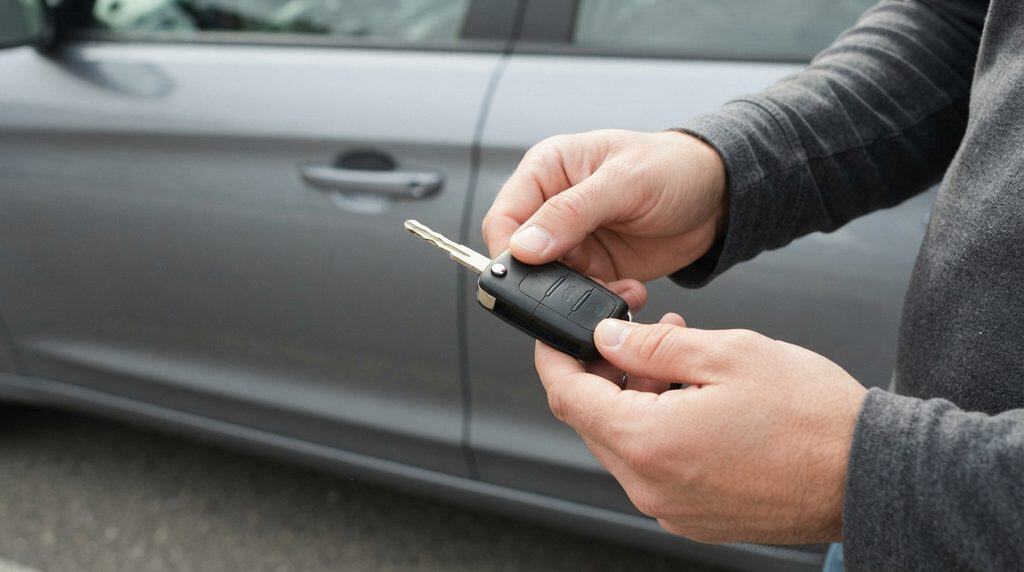
Look for the emergency-entry procedure for your exact year and model. If the paper owner’s manual is locked inside the car, use your phone to check the manufacturer’s online owner’s manual or support page. If a cover has to be removed, follow the documented release method instead of prying around the door handle or nearby trim looking for a lock.
The important point is that a non-working remote does not always mean you are physically locked out. The vehicle may have a mechanical backup even when the electronic buttons are dead.
Emergency: Starting a Push-to-Start Car With a Broken Key Fob
A push-button-start vehicle may also have a backup procedure for a fob with a dead battery or weak electronic signal.
This is where the procedure has to be vehicle-specific.
Some systems instruct you to hold or touch the electronic key against the start switch. Others use a designated key pocket or another documented location inside the vehicle. The location and sequence are not universal.

Do not start pulling up cup holder liners, dashboard panels, console trim, or start-button covers trying to discover a hidden slot.
Instead, use the owner’s manual or, if needed, your phone to check the manufacturer’s online owner’s manual or support page for the exact vehicle and follow that backup-start sequence.
This distinction matters because the coin-cell battery that powers normal remote or smart-key functions is not necessarily what allows the immobilizer system to recognize the key during a backup start. Passive automotive security-transponder technology can operate without that battery supply.
Start With the Symptoms
Before opening the fob, replacing parts, or assuming it needs programming, pay attention to exactly what stopped working.
Does Only One Fob Fail?
If you have a working spare, compare the two.
If the spare works normally from the same place while the problem fob does not, that points you toward the fob itself rather than a problem affecting the entire vehicle.
The next checks are the battery, buttons, housing, contacts, contamination, and electronics inside that particular fob.
Do Both Fobs Behave Abnormally?
If two known-working fobs suddenly have the same problem, do not immediately blame both fobs.
Look at what the rest of the vehicle is doing.
If multiple electrical systems are dead, the vehicle will not start normally, or the smart-key system is failing along with broader electrical symptoms, the vehicle’s 12-volt battery becomes a reasonable separate thing to investigate.
If that sounds closer to what your car is doing, MotorHills has a separate guide to telling whether your car battery is dead or dying.
A failed unlock command by itself is not enough to diagnose the vehicle battery.
Is the Fob Weak or Intermittent?

Maybe the fob still works, but only sometimes. Perhaps you have to press a button repeatedly, stand closer than before, or try again after moving the key.
A weak or dead fob battery is one of the first and easiest things to check on a fob with a normal user-serviceable battery.
If the problem happens mainly in one location, however, radio interference also belongs on the list of possibilities. We will come back to that shortly.
Does Only One Button Have a Problem?

If lock works but unlock does not, or one button feels damaged while the rest of the fob behaves normally, that is different from a completely dead fob.
Look for:
- a torn or collapsed button
- cracked housing
- a button that no longer presses normally
- visible contamination around the button area
- a worn or damaged contact beneath that button
Visible housing or button damage does not automatically mean the circuit board has failed.
Did the Trouble Start After Water or a Drop?
That history matters.
Water, contamination, a hard impact, or aggressive opening can damage contacts, soldered components, the housing, or the circuit board itself.
If the fob stopped working immediately after one of those events, inspect it more carefully before assuming the problem is simply a depleted battery.
Did a Fresh Battery Change Nothing?
That is useful information too.
Once you know the correct battery is installed correctly and the symptoms are unchanged, stop repeatedly replacing batteries. Move to the other diagnostic branches in this guide.
What a Key Fob Is Actually Doing
A modern key fob can perform more than one job.
The buttons and normal smart-key functions use electronics inside the fob to communicate with the vehicle. That is why the fob battery matters for normal remote operation.
Vehicle security and immobilizer recognition can involve a separate passive transponder function.
That is why a fob with a depleted coin-cell may lose normal remote operation but still work with the manufacturer’s documented backup-start method.
This also explains why “the battery is dead, so the entire key is useless” is too simple. Different functions inside the key system can fail or continue working independently.
Replace a User-Serviceable Fob Battery First
If your fob has a normal battery that the manufacturer expects the owner to replace, this is a sensible early DIY check.

Before removing anything, identify the complete battery designation and pay attention to how the old battery is installed.
Do not rely only on visual size. Coin cells can look very similar while having different model numbers and specifications.
How to Replace It
- Check the fob or vehicle instructions for the correct opening method and battery specification.
- Before removing the old battery, note its complete designation and orientation. A quick photo can make reassembly easier.
- Use an appropriately sized tool and avoid excessive force when separating the housing. Work with dry hands, and avoid unnecessarily touching or shifting the circuit board, bending battery terminals, or disturbing small components.
- Keep both the new and removed coin or button battery away from children. Swallowing one can cause severe internal injury and requires emergency medical attention.
- Install the same battery type or the manufacturer-recommended equivalent in the documented orientation.
- Reassemble the fob carefully and test it.
Do not force a cover that does not want to separate. Excessive force can damage or deform the housing, and a screwdriver pushed too far into the fob can damage far more than the battery compartment.
If your fob does not have a documented user-serviceable battery procedure, this article is not a reason to start desoldering components from the circuit board.
If a Fresh Battery Did Not Fix It
A new battery narrows the problem, but it does not automatically tell you what failed.
Work through the next checks.
Confirm the Simple Things First
Make sure:
- the complete battery designation is correct
- the battery is installed in the correct orientation
- it is seated properly
- the housing closed without shifting or damaging internal parts
If a spare fob is available, compare it again from the same location.
A working spare makes a problem inside the other fob more likely.
If neither fob behaves normally and the vehicle has other electrical symptoms, return to the vehicle-side branch rather than taking both keys apart.
Check the Buttons and Housing
A damaged shell is easier to spot than an electronics failure.
Look for cracks, broken button areas, missing pieces, or a key-ring section that has snapped away.
If the outside of the fob is physically damaged but the electronics still respond normally, do not automatically condemn the circuit board.
Replacement housings and button components may exist for some fobs, but exact compatibility has to be established for the specific key. Do not assume that two housings that look alike are interchangeable or that the internal electronics can always be transferred safely.
If you are unsure whether the housing is compatible with the board, buttons, emergency key, or other integrated parts, stop before turning a cosmetic repair into an electronics problem.
Inspect Dirty Contacts, Contamination, and Corrosion
If you are comfortable opening a user-serviceable fob, inspect the accessible circuit-board area without digging at components.
Look for:
- obvious dirt or contamination
- corrosion
- damaged button contacts
- loose-looking components
- cracked areas
- signs that liquid reached the board
If the contacts are visibly dirty and safely accessible, ALOA’s consumer guidance recommends rubbing alcohol applied with a small soft brush or cloth.
Use a controlled amount. Do not soak the circuit board.
Cleaning is not a reasonable answer for severe corrosion, missing components, loose soldered parts, or obvious board damage. Those problems have moved beyond routine contact cleaning.
Be Careful When Opening the Fob
There is a useful firsthand MotorHills example behind this warning.
Ernest has repaired a key-fob circuit board after someone tried to pry the housing open quickly with a flat-head screwdriver. Tiny components were torn from the circuit board in the process, and repairing the damage required microscope-level work and steady hands.
The original problem was not necessarily a ruined circuit board. The aggressive opening attempt created one.

That is why a careful battery replacement and a board-level electronics repair belong in very different DIY categories.
If the fob is not separating the way its documented procedure says it should, forcing a screwdriver farther inside is not troubleshooting.
Consider Water or Impact Damage
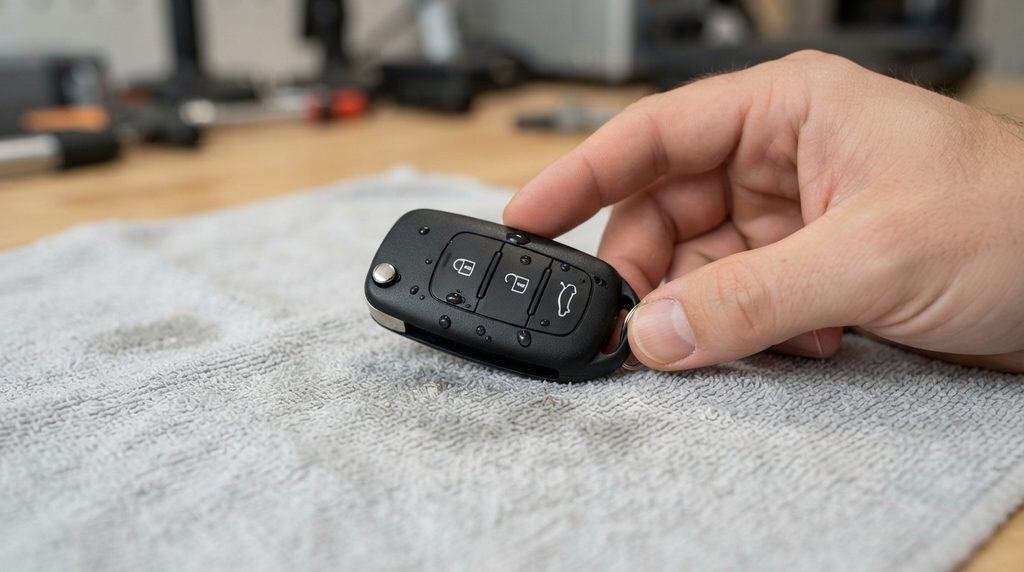
If the problem began after the fob was dropped, crushed, soaked, or exposed to contamination, inspect the housing and board more critically.
A hard impact can create physical damage even when the plastic exterior still looks usable. Liquid exposure can leave contamination or corrosion around contacts and small components.
Do not assume every damaged circuit board is automatically beyond repair, though.
Board-level damage may be repairable in some situations and impractical in others. What matters is the actual damage, the available parts, and whether someone has the electronics skill to work safely on small soldered components.
Significant corrosion, loose components, broken solder joints, or other obvious PCB damage are good places for routine beginner DIY work to stop.
Consider Radio Interference
Radio interference is not the default explanation for every unreliable fob, but it becomes more interesting when the problem is strongly location-dependent.
For example, if the same fob works normally somewhere else but repeatedly struggles in one particular parking area or near strong electronic or metallic interference, the surroundings may be affecting smart-key communication.
Move away from the suspected area or nearby object and test the fob again.
If normal operation returns consistently elsewhere, that gives you a different clue than a fob that fails everywhere.
Do not use interference as an excuse to ignore an obviously damaged fob, dead battery, or broader vehicle electrical problem. It is one branch of the diagnosis, not a universal answer.
When the Fob Is No Longer Recognized
Programming and recognition problems need to be separated from simple battery replacement.
A fob can be physically intact and still not be correctly registered or recognized by the vehicle’s security system.
This is also where generic programming recipes become risky and misleading.
Some vehicles support a documented owner or on-board programming process. Others require vehicle-specific key registration, immobilizer programming, security authorization, or security-capable diagnostic equipment.
There is no single “common universal” sequence that should be tried across different makes and key systems.
If the vehicle supports DIY programming, use the exact procedure and prerequisites documented for that vehicle and key type.
For the broader topic, MotorHills also has a guide on how to program a car key fob without visiting the dealership. Treat the procedure as vehicle-specific rather than assuming one sequence works everywhere.
If the system requires immobilizer or security programming beyond the documented owner procedure, that is a reasonable stopping point for normal DIY troubleshooting.
Who Can Fix a Broken Car Key Fob?
There are really several different levels of key-fob work.
Beginner DIY
DIY makes the most sense when the job is limited to something such as:
- checking the symptoms
- comparing the problem fob with a spare
- replacing a documented user-serviceable battery
- inspecting obvious physical damage
- checking safely accessible contacts
- recognizing contamination or corrosion
- testing whether a problem appears to be location-dependent
These checks can tell you a lot before you pay for a complete key replacement.
Electronics Repair
A damaged PCB is different from a dead battery.
If tiny soldered components are loose, the board is badly corroded, traces or contacts are damaged, or repair would require soldering beyond your skill level, the job has moved into electronics-repair territory.
That does not mean the board is automatically unrepairable. It means the repair requires a different level of skill and equipment.
If You Need a Complete Replacement Fob
If the original fob is too damaged to reuse, a compatible replacement remote may be another option before going straight to an OEM replacement.
For certain Chevrolet, Buick, Pontiac, and Saturn applications that use part number 22733524 / KOBGT04A, MotorHills recommends this 2-pack replacement keyless-entry remote-start key fob.

This is not a universal replacement fob. Confirm the exact part number, button layout, vehicle compatibility, and programming requirements before ordering. The listing states that dealer or automotive-locksmith programming is required.
Automotive Locksmith
A qualified automotive locksmith can handle many key-related services, including key cutting and security-related programming on supported vehicles.

The exact capability depends on the vehicle, key system, required security access, and the locksmith’s equipment and credentials.
If you are calling one, describe the exact year, make, model, key type, symptoms, and whether you still have a working key.
Dealer or OEM Involvement
Some situations may still require dealer or OEM involvement because of the specific key, security system, required access, or programming process.
That is a vehicle-specific decision, not a rule that dealership programming is always more capable than automotive-locksmith programming.
An all-keys-lost situation can also be very different from adding or repairing a second key because the vehicle’s security system may require additional verification and programming steps.
What Key Fob Repair Costs Depend On
There is no useful single price for “fixing a key fob.”
A battery replacement is a very different job from:
- replacing damaged physical parts
- repairing circuit-board damage
- cutting a mechanical key
- registering or programming a key
- performing immobilizer or security work
- handling an all-keys-lost situation
- sourcing a vehicle-specific OEM key
That is why diagnosing the failure before ordering a complete replacement matters.
If the problem turns out to be a simple battery, dirty contact, or isolated physical issue, replacing the whole programmed key may be unnecessary. If the electronics or security side has failed, the appropriate next step may be an electronics specialist, automotive locksmith, dealer, or OEM procedure instead.
Start Simple Before Replacing the Whole Key
A broken-looking or unresponsive key fob is not one diagnosis.
Start by asking whether one fob fails or both, whether the vehicle has broader electrical symptoms, whether the problem is intermittent, whether a fresh battery changes anything, and whether there is evidence of physical, water, contamination, or circuit-board damage.
Use the vehicle’s documented emergency-entry and backup-start procedure if normal operation is unavailable. If the fob has a normal user-serviceable battery, that is an easy early check, but do not keep replacing batteries once the evidence points somewhere else.
The useful stopping point is when the problem requires significant board-level repair, soldering beyond your skill, severe corrosion work, unknown integrated components, or immobilizer and security programming.
At that point, you are no longer guessing. You have narrowed the problem enough to choose the right kind of help.
External Resources
- Toyota: How to unlock and start a vehicle when an electronic key does not operate normally
- Chevrolet: Using Keyless Open and Keyless Start when the fob loses battery or signal power
- NXP: Passive automotive security-transponder and keyless-entry/start technology
- Toyota: Electronic key battery replacement, coin-cell precautions, and careful fob opening
- Panasonic Energy: Coin lithium battery types, model numbers, and dimensions
- ALOA Security Professionals Association: Consumer key-fob troubleshooting and automotive locksmith guidance
- NASTF: Vehicle Security Professionals and security-related key programming
- NASTF: Security-capable scan-tool functions including adding keys and immobilizer work
- Toyota: Smart-key radio communication and interference conditions
- Toyota: How a discharged vehicle 12-volt battery can affect starting and smart-key operation


