Skip to content

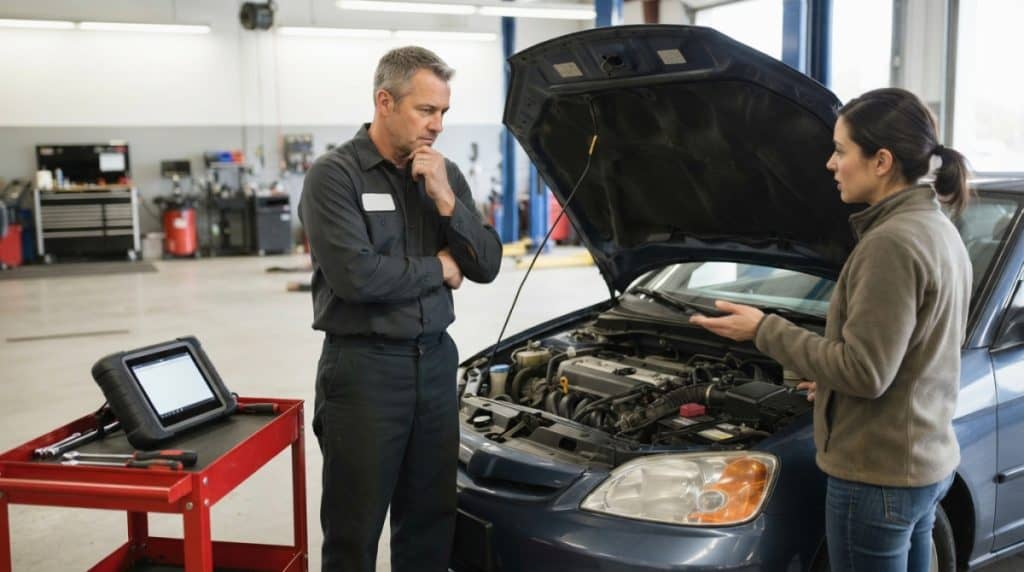
Hearing a knock from your engine can make you assume the worst. However, not every metallic rattle means the connecting-rod bearings are failing.
Spark knock and rod knock come from completely different problems.
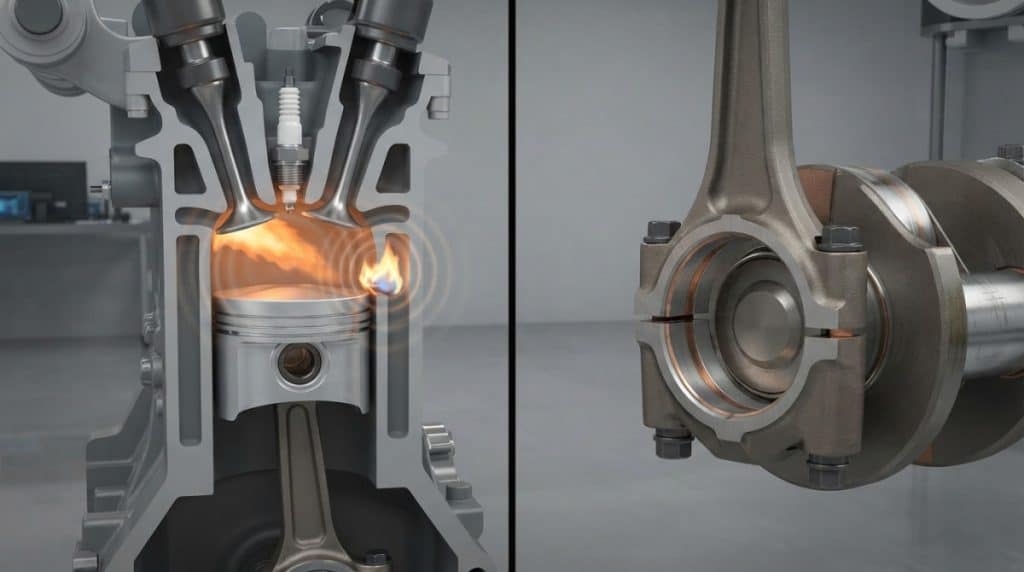
Spark knock is an abnormal combustion noise that usually appears when the engine is working hard. Rod knock is a mechanical noise caused by excessive clearance or damage around a connecting-rod bearing.
One may be corrected by addressing the fuel, engine temperature, ignition timing, tune, or sensor problem. The other often means the engine needs major internal repair.
The most useful clue is not only how the noise sounds. Pay attention to when it happens, where it seems to come from, and what happens when you ease off the accelerator.
Quick Answer: Spark Knock vs. Rod Knock
Spark knock usually sounds like a light metallic ping or a handful of marbles rattling in a can. It commonly appears while accelerating, climbing a hill, towing, or placing the engine under heavy load. The noise often becomes quieter or disappears when you lift off the accelerator.
Rod knock is usually deeper, heavier, and more rhythmic. Once the bearing damage is advanced, it may be audible at idle and will normally speed up as engine RPM rises.
The easiest way to remember the difference is:
- Spark knock follows engine load.
- Rod knock follows engine speed and mechanical movement.
If the knock is deep, remains present at idle, or appears with an oil-pressure warning, shut the engine off and arrange an inspection. Do not repeatedly rev the engine to make the sound easier to identify.
Spark Knock vs. Rod Knock at a Glance
| Clue | Spark Knock | Rod Knock |
| Typical sound | Light ping, rattle, or metallic clatter | Deep, heavy, rhythmic knock |
| When it happens | Usually under load or acceleration | Often audible at idle once advanced and gets faster with RPM |
| Likely source | Combustion chambers | Lower engine and crankshaft area |
| Response when you lift off the accelerator | Often quiets or disappears | May change but usually does not disappear completely |
| Response to the correct fuel octane | May improve if fuel was the cause | No |
| Usual severity | Needs diagnosis but may be correctable | Existing mechanical damage is likely |
These are patterns, not guarantees. Engine noises travel through the block, exhaust, brackets, and accessories, so pitch and apparent location alone cannot confirm the failed part.
Before You Panic: Is It Even Rod Knock?
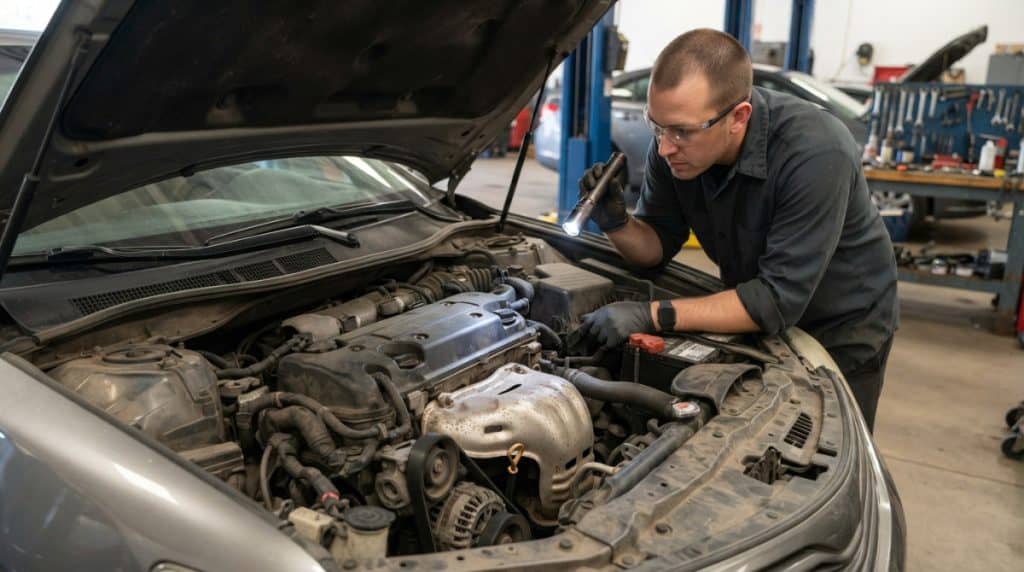
Rod knock is not the only problem that can produce a knock, tick, or rattle.
Several less serious or differently serious issues can sound alarming from inside the car. Rule out these possibilities before assuming the engine needs replacement.
Piston Slap
Piston slap is often described as a hollow knock from the middle of the engine.
On some engines, it is loudest immediately after a cold start and becomes quieter as the pistons and cylinders warm and expand. That pattern is less typical of advanced rod knock.
However, a noise that fades when warm is only a clue. Piston, wrist-pin, and cylinder-wall problems can still require repair, especially when the sound becomes louder or lasts longer than it used to.
Some manufacturers have issued service bulletins describing temporary cold-start piston noise on specific engines. Check for information that applies to the exact year, model, and engine before assuming the sound is normal.
Lifter or Valvetrain Tick
Lifter, rocker-arm, valve-clearance, and camshaft noises tend to sound lighter and faster than rod knock.
They are usually loudest near the valve cover at the top of the engine. Some become quieter after oil pressure builds, while others remain after the engine warms.
Direct-Injection Injector Tick
Gasoline direct-injection systems can make a sharp, rapid ticking sound.
The injectors and high-pressure fuel pump operate at much higher pressure than older port-injection systems, so some ticking may be normal. A steady, even tick across the engine is generally less concerning than a new isolated knock that has suddenly become louder.
Exhaust Leak
A small exhaust-manifold or gasket leak can sound like a metallic tick, particularly when the engine is cold.
The sound may soften as the exhaust components heat up and expand. Black soot near the manifold or gasket area can also point toward a leak.
Loose Heat Shield or Accessory
A loose heat shield, pulley, belt tensioner, engine cover, bracket, or accessory can change rhythm with RPM and imitate an internal engine problem.
Checking the external components first can prevent a loose part from being mistaken for a failed bearing.
Other Internal Engine Noises
Connecting-rod bearings are not the only internal components that can knock.
Main bearings, piston pins, pistons, crankshaft components, and damaged flexplates or flywheels may create similar sounds. Confirming the exact source may require oil-pressure testing, cylinder isolation, or internal inspection.
Knock vs. Tick: What Is the Difference?
A tick is usually lighter, sharper, and faster than the deep thud associated with rod knock. It often comes from the top or front of the engine rather than the lower crankshaft area.
Common sources of ticking or rattling include:
- Fuel injectors
- Lifters and rocker arms
- Valve-clearance problems
- Small exhaust leaks
- Timing chains and tensioners
- Camshaft-adjustment components
- Loose heat shields, pulleys, or brackets
The distinction becomes harder when a timing-chain problem produces more than a light tick.
If a timing-chain guide, tensioner, or related component wears or breaks, the chain can develop enough slack to rattle or strike nearby parts. The result may sound like a rapid tick, a metallic rattle, or even a heavier knocking noise.
The sound may be most noticeable:
- During startup
- At idle
- Near the front of the engine
- Within a particular RPM range
- Before normal oil pressure fully reaches the tensioner
Some BMW engines provide a useful example. BMW’s VANOS system adjusts camshaft timing, while the engine’s timing-chain system drives the camshafts and related timing components. Wear or damage involving the chain guides, tensioner, or nearby timing components can produce ticking, rattling, or knocking noises that may be mistaken for rod knock.
It is more accurate to call this a timing-chain or VANOS-related noise rather than a “VANOS chain” problem.
The general clues are:
- Light, rapid noise from the top: injector or valvetrain tick is more likely.
- Rattle from the front of the engine: timing-chain, tensioner, or cam-timing trouble is possible.
- Deep rhythmic knock from the lower engine: rod or main-bearing damage becomes more concerning.
These clues narrow the search, but they do not confirm the failed part. A timing-chain rattle should not automatically be dismissed as harmless. If the chain becomes loose enough to jump timing, the engine can suffer serious internal damage.
What Spark Knock Actually Is
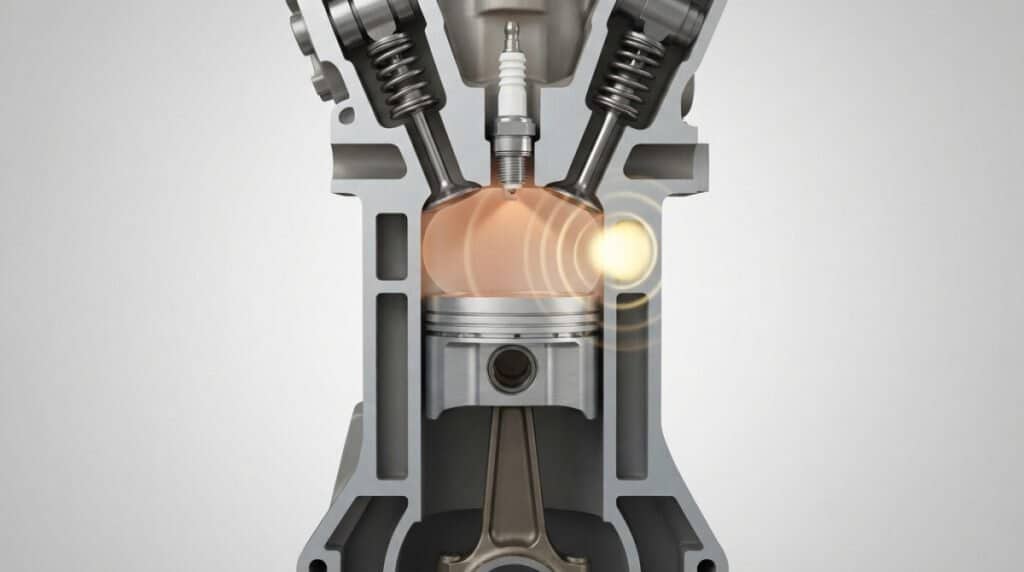
In normal combustion, the spark plug ignites the air-fuel mixture and a controlled flame travels across the combustion chamber.
During spark knock, also called detonation, part of the remaining mixture auto-ignites after the spark instead of burning smoothly with the main flame front. The resulting pressure waves make the engine structure ring, creating the pinging or rattling noise.
Spark knock commonly appears during:
- Hard acceleration
- Climbing a hill in a high gear
- Towing or carrying a heavy load
- Low-RPM driving with the throttle open
- Hot weather
- Engine overheating
- High turbocharger boost
- High intake-air temperatures
Common causes include:
- Fuel below the required octane rating
- Excessive ignition timing
- An aggressive or incorrect tune
- A lean air-fuel mixture
- Cooling-system problems
- Combustion-chamber deposits
- Incorrect spark plugs
- Excessive boost
- Faulty airflow, temperature, or pressure sensors
- A damaged knock sensor or related wiring
Modern engines use knock sensors to detect vibration associated with detonation. The engine computer may respond by reducing ignition timing.
That protection has limits. Persistent audible pinging should not be dismissed simply because the engine has a knock sensor.
Spark Knock Is Not the Same as Pre-Ignition
Spark knock and pre-ignition are often confused, but they describe different events.
Spark knock or detonation occurs after the spark plug fires. Part of the remaining mixture burns abnormally and produces sharp pressure waves.
Pre-ignition begins before the spark. The mixture may be ignited by an overheated spark plug, glowing deposit, or another hot surface inside the combustion chamber.
Both can damage an engine, but severe pre-ignition can cause major damage very quickly.
Repeated abnormal combustion may damage:
- Pistons
- Piston ring lands
- Spark plugs
- Valves
- Head gaskets
- Connecting-rod and main bearings
Spark knock may be corrected before that damage occurs, but the cause still needs to be identified.
What Rod Knock Actually Is
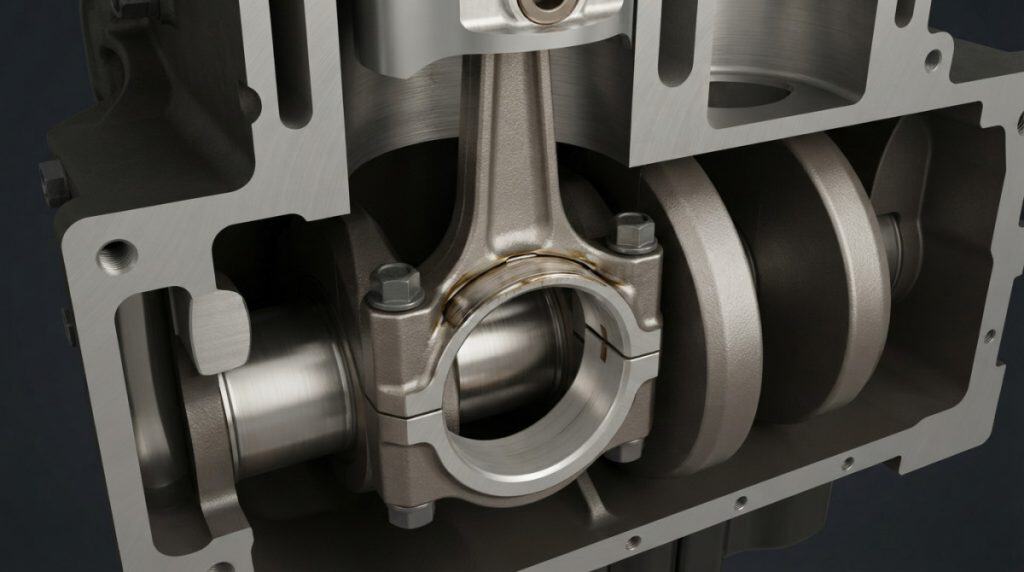
Connecting rods join the pistons to the crankshaft.
At the lower end of each rod, a bearing and a thin film of pressurized oil prevent the connecting rod from striking the crankshaft journal.
When the bearing wears, loses lubrication, spins, or develops excessive clearance, the rod can begin hammering against the crankshaft journal.
That impact creates the deep, rhythmic sound associated with rod knock.
Common causes include:
- Low engine-oil level
- Loss of oil pressure
- A blocked oil pickup
- A failing oil pump
- Oil starvation during hard acceleration or cornering
- Dirty or contaminated oil
- Excessive bearing clearance
- Over-revving
- Incorrect engine-rebuild clearances
- Improper rod-bolt installation
- An overheated or spun bearing
Rod knock normally becomes faster as engine RPM increases. It may also become louder under load because combustion pressure places more force on the connecting rod.
Some rod-bearing noises become easier to hear after the oil warms and becomes thinner. However, the behavior varies depending on the engine and how far the damage has progressed.
A change during acceleration or deceleration may provide a clue, but no single throttle pattern proves that a rod bearing has failed.
How to Tell Which Knock You Are Hearing
The best diagnosis combines several clues. Do not approve an engine rebuild based only on a phone recording or a description such as “marbles in a can.”
Step 1: Check When the Noise Happens
Start by identifying the exact operating condition.
Ask:
- Is the noise present at idle?
- Does it happen only during acceleration?
- Does it appear while climbing a hill?
- Does it happen at low RPM in a high gear?
- Does it stop when you ease off the accelerator?
- Is it louder cold or warm?
- Did it begin after refueling?
- Did the engine recently overheat?
- Has the engine recently run low on oil?
- Did the noise begin after tuning or engine work?
A light metallic rattle that appears only under load points more strongly toward spark knock.
A deep knock that remains at idle and speeds up with RPM deserves immediate investigation for a bottom-end problem.
A rattle that is strongest during startup or near the front of the engine may instead involve a timing chain, tensioner, cam phaser, or accessory.
Step 2: Listen to the Character of the Noise
Mechanics often describe spark knock as:
- Marbles rattling in a metal can
- A light metallic ping
- A rapid hollow clatter
- A brief rattle during acceleration
Rod knock is more often described as:
- A hammer striking metal
- A deep rhythmic thud
- A heavy knock from inside the block
- A low sound that follows engine RPM
A tick is generally lighter and sharper. It may sound like a pen tapping rapidly against a hard surface.
Sound descriptions are subjective. What one person calls a ping, another may call a tick or rattle. Always compare the sound with the operating conditions and apparent location.
Step 3: Identify the General Location
The apparent location may help narrow the search.
A noise near the upper engine may involve:
- Fuel injectors
- Valvetrain components
- Combustion knock
- Exhaust leaks
A noise near the front of the engine may involve:
- Belt tensioners
- Pulleys
- Accessories
- Timing chains
- Chain guides
- Cam phasers or VANOS-related components
A noise from the lower block or oil-pan area may involve:
- Rod bearings
- Main bearings
- Crankshaft components
- Pistons or piston pins
An experienced technician may use a mechanic’s stethoscope to compare different parts of the engine.
Working near belts, pulleys, cooling fans, and hot exhaust components is dangerous. This type of check is better left to someone familiar with working around a running engine.
Step 4: Check the Fuel and Engine Load
Use the octane rating specified by the vehicle manufacturer.
If the vehicle requires or recommends premium fuel and the noise began after filling with lower-octane gasoline, returning to the correct fuel may reduce spark knock.
That does not mean premium fuel repairs every pinging engine.
If the vehicle is already using the correct fuel and still knocks under load, possible causes include:
- Excessive engine temperature
- A lean mixture
- Incorrect ignition timing
- Carbon deposits
- Excessive boost
- Faulty sensors
- Fuel-delivery problems
Higher octane cannot repair rod-bearing damage. A deep mechanical knock that remains at idle will not disappear because premium fuel or an octane booster was added.
If the knock appears alongside a rising temperature gauge, stop placing the engine under load and address the overheating problem. Read our guide on how far you can drive an overheating car before deciding whether to continue.
Step 5: Check the Oil Level and Warning Lights
Check the engine-oil level according to the owner’s manual.
Do not continue running the engine if:
- The oil-pressure warning light is on
- The oil-pressure gauge suddenly reads low
- The oil level is dangerously low
- The knock began after a major oil leak
- The noise is deep, heavy, and becoming louder
Low oil pressure combined with a mechanical knock is an immediate warning sign.
Do not assume the pressure sensor is faulty until the actual oil pressure has been tested. Our guide on whether it is dangerous to drive with a bad oil-pressure sensor explains why the warning should still be taken seriously.
Step 6: Scan the Engine Computer
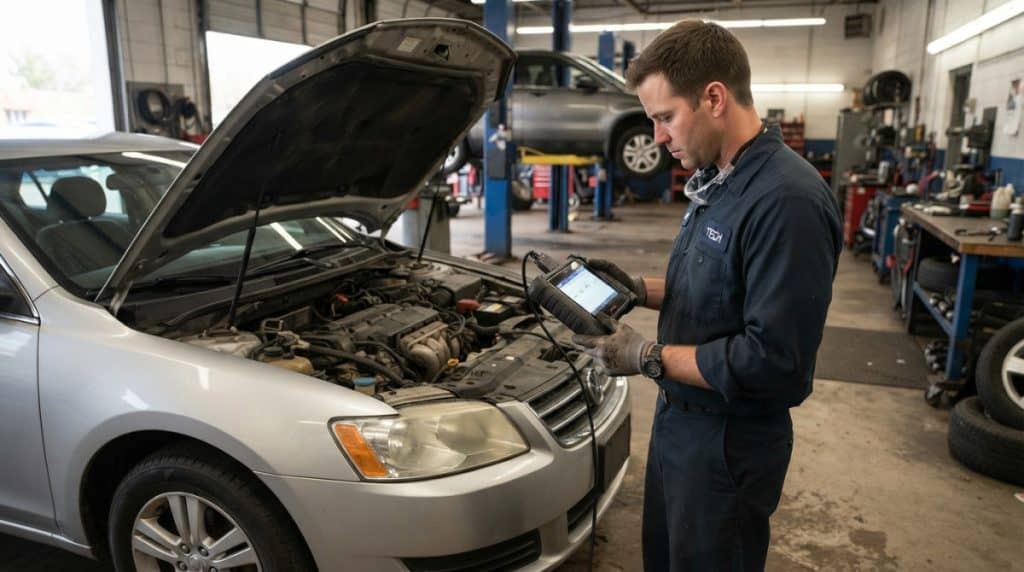
A diagnostic scan may reveal trouble codes involving:
- Knock sensors
- Lean fuel mixtures
- Fuel delivery
- Airflow sensors
- Intake-air temperature
- Coolant temperature
- Misfires
- Boost control
- EGR operation
- Camshaft timing
- Camshaft and crankshaft correlation
More advanced scan tools may display:
- Ignition timing
- Knock retard
- Fuel trims
- Intake-air temperature
- Coolant temperature
- Misfire counts
- Boost pressure
- Requested and actual camshaft position
Repeated ignition-timing correction under the same load may support a spark-knock diagnosis.
Camshaft timing or correlation faults may support a timing-chain, tensioner, or cam-adjustment diagnosis.
However, scan data must be interpreted for the specific engine. Mechanical noise can sometimes affect knock-sensor readings, and not every vehicle reports knock information in the same way.
A misfire can also make the vehicle stumble or jerk while accelerating. See our guide to why a car jerks during acceleration or slowing down for related fuel, ignition, and airflow checks.
Step 7: Have a Technician Perform a Cylinder Cutout Test
A cylinder cutout or power-balance test can help identify a cylinder-specific mechanical problem.
Using an appropriate scan tool, a technician briefly disables combustion in one cylinder at a time.
If a heavy knock becomes much quieter when one cylinder is disabled, reducing the combustion load on that cylinder has changed the noise. That may point toward its rod bearing, piston pin, or piston assembly.
The test is an important clue, but it does not prove that the rod bearing is the only possible cause.
Manually disconnecting coils, injectors, or spark-plug wires from a running engine is not recommended as a general DIY test. It can create electrical hazards, damage connectors, trigger diagnostic trouble codes, and send unburned fuel into the catalytic converter.
Step 8: Verify Oil Pressure
A technician can connect a mechanical oil-pressure gauge and compare the readings with the manufacturer’s specification.
The test must be performed at the correct oil temperature and engine speed because oil pressure naturally changes with temperature and RPM.
Worn bearings may allow too much oil to escape around the journals, reducing pressure. However, a normal dashboard reading does not completely rule out damage to one bearing.
Step 9: Inspect the Oil and Filter
Draining the oil and opening the filter may reveal metal debris.
A sudden amount of metallic glitter, flakes, or chips is concerning, particularly when it appears with a new knock or low oil pressure.
Debris color can provide clues, but it should not be treated as a perfect identification method.
Engine bearings may contain steel backings, copper-containing layers, aluminum alloys, and thin overlay materials. Silver-colored debris may also come from several other engine components.
A spin-on oil filter should be opened with a proper oil-filter cutter. Using a hacksaw introduces metal filings and makes the evidence harder to interpret.
Final confirmation may require removing the oil pan or timing covers and inspecting:
- Rod bearings
- Main bearings
- Crankshaft journals
- Bearing clearances
- Oil pickup
- Oil pump
- Timing chains
- Chain guides
- Tensioners
- Camshaft-adjustment components
- Metal contamination throughout the engine
What Should You Do Right Now?
Your next step depends on the type of noise.
If It Sounds Like Spark Knock
Ease off the accelerator and avoid placing the engine under heavy load.
Then:
- Confirm that the vehicle has the recommended fuel.
- Check the engine temperature.
- Avoid lugging the engine in a high gear.
- Scan for trouble codes.
- Have persistent knock diagnosed before towing, hard acceleration, or aggressive driving.
Spark knock may be correctable, but repeated detonation can still damage the engine.
If It Sounds Like a Tick or Timing-Chain Rattle
Do not assume the engine is about to throw a connecting rod, but do not ignore a new or worsening noise.
Have it inspected promptly if:
- The sound is becoming louder
- It lasts longer after startup
- It comes from the front of the engine
- Camshaft timing codes are present
- The engine runs roughly
- Power has decreased
- The noise began after an oil-pressure problem
A failed timing guide or tensioner can eventually allow the chain to jump timing, which may cause major engine damage.
If It Sounds Like Rod Knock
Do not continue revving the engine to make the sound easier to hear.
Shut it off and arrange an inspection or tow, especially when the knock is:
- Deep and rhythmic
- Present at idle
- Becoming louder quickly
- Accompanied by low oil pressure
- Associated with metal in the oil
- Related to recent oil loss
There is no dependable number of miles an engine can safely travel with rod knock.
It may continue running for some time, or it may fail during the next acceleration. Continuing to drive can turn a damaged bearing and crankshaft into a broken connecting rod, damaged engine block, and unusable engine.
How Spark Knock Is Repaired
The correct repair depends on the cause.
Possible fixes include:
- Filling with the manufacturer-recommended fuel
- Replacing incorrect or damaged spark plugs
- Repairing an overheating problem
- Correcting ignition timing
- Repairing a vacuum leak
- Correcting fuel-pressure or injector problems
- Replacing a faulty knock sensor
- Repairing airflow or temperature sensors
- Reducing excessive boost
- Correcting an unsafe engine tune
- Addressing confirmed combustion deposits
Do not assume that a fuel additive will solve every spark-knock problem. Deposits are only one possible cause, and some engines require mechanical cleaning rather than chemicals added to the fuel tank.
How Rod Knock Is Repaired
Rod-knock repair is normally much more involved.
Installing a replacement bearing from underneath may quiet some engines temporarily, but it is not automatically a lasting repair.
By the time a bearing is knocking, the crankshaft journal may already be:
- Scored
- Overheated
- Tapered
- Out of round
- Covered in transferred bearing material
Metal may also have circulated through the oil pump, oil passages, turbocharger, camshafts, and other lubricated components.
A proper repair may require:
- Removing and disassembling the engine
- Measuring the crankshaft journals
- Machining or replacing the crankshaft
- Replacing damaged connecting rods
- Installing new bearings
- Cleaning the oil passages
- Inspecting or replacing the oil pump
- Rebuilding the engine
- Installing a used or remanufactured engine
The most economical choice depends on the vehicle’s value, engine availability, labor costs, and the amount of internal damage.
How to Reduce the Risk of Engine Knock
Spark-knock prevention mainly involves controlling combustion temperature and pressure:
- Use the recommended fuel octane.
- Keep the cooling system working properly.
- Install the correct spark-plug type and heat range.
- Repair lean mixtures and fuel-delivery problems.
- Fix airflow and temperature-sensor faults.
- Use conservative, properly tested tuning.
- Monitor boost and intake temperature on modified engines.
Preventing rod-bearing and timing-system damage mostly comes down to proper lubrication and maintenance:
- Keep the engine oil at the correct level.
- Use the specified oil viscosity and quality.
- Change the oil and filter at an appropriate interval.
- Repair leaks before the oil level becomes dangerously low.
- Never ignore an oil-pressure warning.
- Investigate new startup rattles or timing faults.
- Avoid sustained over-revving.
- Use correct bearing clearances and assembly procedures during engine work.
Maintenance cannot prevent every engine failure, but proper lubrication and quick action after an oil-pressure or timing-system warning can prevent more extensive damage.
Frequently Asked Questions
Can you drive with rod knock?
No safe driving distance can be guaranteed. Audible rod knock usually means the bearing and possibly the crankshaft journal are already damaged. Continued operation can spread metal debris, spin the bearing, damage the crankshaft, or allow the connecting rod to fail. Arrange a tow.
Does higher-octane fuel fix rod knock?
No. Octane affects gasoline’s resistance to combustion knock. It cannot repair damaged bearings, excessive clearance, or a scored crankshaft journal.
Can rod knock be fixed without replacing the engine?
Sometimes. An engine may be rebuilt if the block, crankshaft, rods, and other components can be repaired. However, simply installing a new bearing without measuring the crankshaft journal is rarely a dependable repair.
How long will an engine last with rod knock?
There is no reliable estimate. It might continue running temporarily or fail during the next acceleration. The sound does not reveal how much bearing material remains or how close the connecting rod is to failing.
Is spark knock serious?
It can be. A brief light ping caused by incorrect fuel may stop after the correct fuel is restored. Persistent or heavy knock can damage pistons, rings, head gaskets, spark plugs, and bearings.
Can a bad knock sensor cause spark knock?
A failed knock sensor may prevent the engine computer from responding properly to detonation. However, fuel quality, temperature, timing, mixture, deposits, wiring, and other sensor readings must also be checked.
Can a timing chain sound like rod knock?
Yes. A loose chain, worn guide, weak tensioner, or camshaft-timing component can produce rattling or knocking noises. These sounds are often strongest near the front of the engine or during startup, but proper diagnosis may require scan data and direct inspection.
Can an engine knock without having rod knock?
Yes. Piston slap, valvetrain noise, injector tick, exhaust leaks, timing-chain problems, loose accessories, main-bearing damage, and spark knock can all produce knocking or ticking sounds.
Listen to When the Knock Happens
A light metallic rattle that appears under load and stops when you ease off the accelerator points toward spark knock.
A sharp tick from the top or a rattle from the front of the engine may involve injectors, valvetrain parts, a timing chain, tensioner, or camshaft-adjustment system.
A deep rhythmic knock that remains at idle, follows engine RPM, or appears with low oil pressure points toward serious mechanical damage.
Sound gives you the first clue. Operating conditions, scan data, oil-pressure testing, cylinder isolation, and internal inspection confirm the cause.
If the knock is deep, low in the engine, and present at idle, shut the engine off before the damage gets worse.
External Resources
- Bosch Mobility: Knock Sensor Operation
- U.S. Department of Energy: Fuels and Octane Glossary
- SAE International: Uncontrolled Combustion in Spark-Ignition Engines
- SAE International: Knock Damage Mechanisms in Spark-Ignition Engines
- MAHLE: Bearing Failure Prevention
- MAHLE: Engine Component Failure Analysis
- General Motors Service Bulletin: Engine Knock During Cold Start
- BMW Service Information: Timing-Chain and Guide Inspection