 Skip to content

Why Every Car Owner Needs a Multimeter
Pop the hood of any modern car and you’ll see wires, sensors, and connectors everywhere. When something goes wrong, half the battle is figuring out if the problem is electrical, mechanical, or both. A multimeter is the one tool that lets you peek behind the curtain.

The good news? You don’t need to be an engineer to use one. With less than $30 and a few minutes of practice, you can check your battery, confirm if your alternator is charging, test fuses without pulling them, and even spot broken wires. In this guide, we’ll stick to just three modes that cover 90% of beginner car diagnostics: voltage, resistance (ohms), and continuity.
What a Multimeter Actually Does
Think of a multimeter as a translator for electricity. It tells you:
- Is power present? (voltage mode)
- Is this circuit intact or broken? (continuity mode)
- Does this part have the right internal resistance? (ohms mode)
Cars run on DC power (direct current), not household AC, so most of your readings will be in the DC voltage range. Once you understand that, the tool becomes a lot less intimidating.
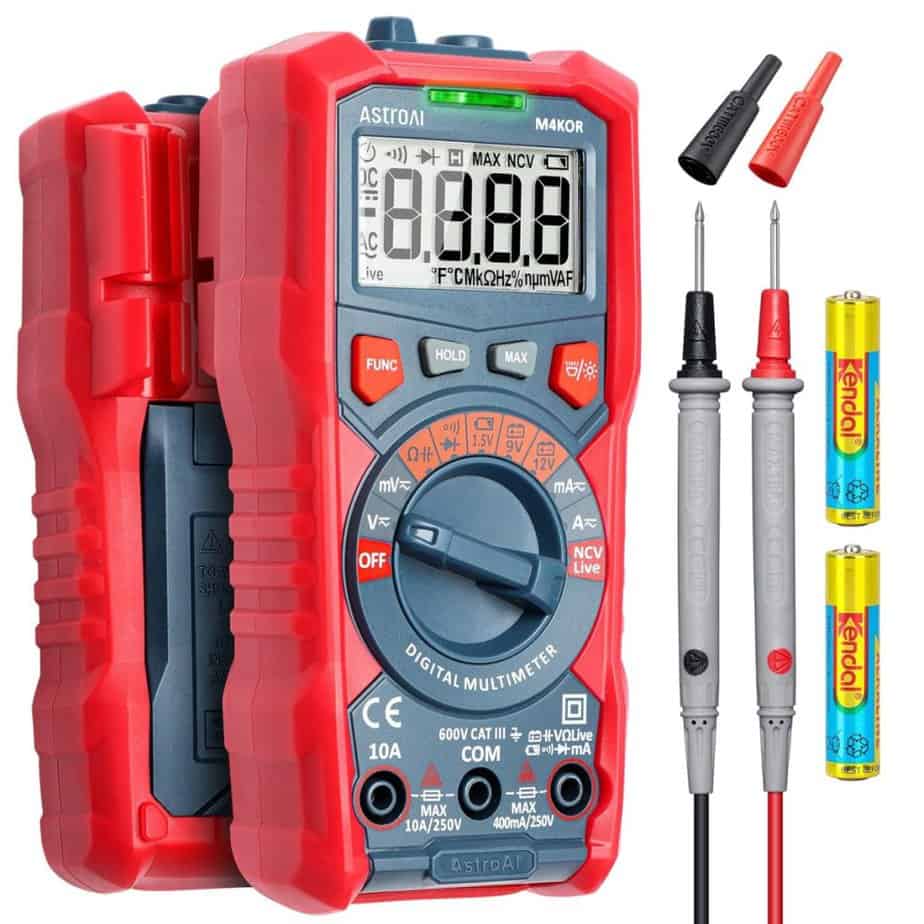
If you’re just starting out, a good entry-level option is something like the AstroAI Multimeter Tester, TRMS 4000 Counts Volt Meter Auto-Ranging Ohmmeter. It handles DC voltage, continuity, resistance, and more, so you’ll be covered for the exact tests we’re about to walk through.
The Three Modes Every Beginner Should Know
Voltage Mode (V) — Checking Power Supply
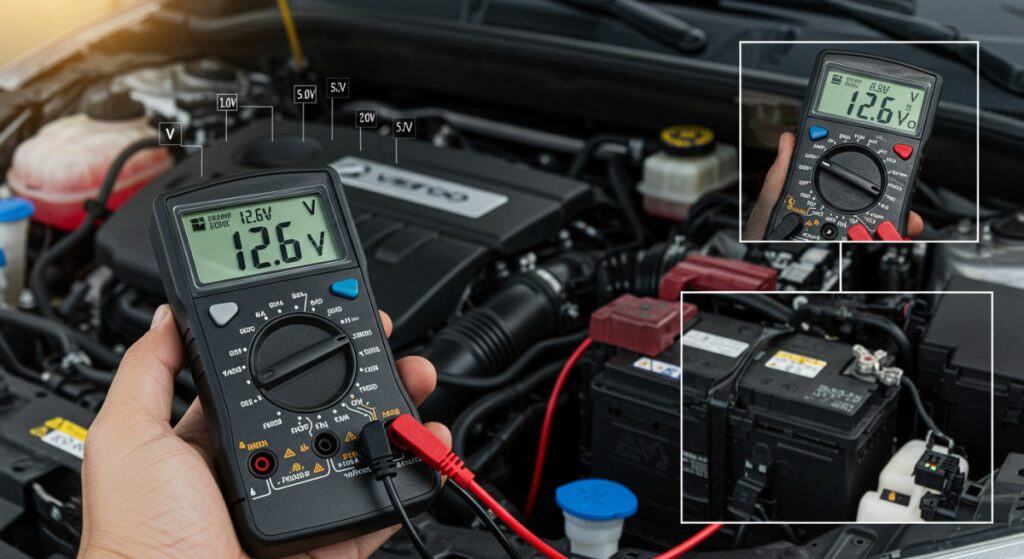
This is your most-used setting. Voltage mode shows whether a circuit has the power it needs. For cars, that usually means looking for 12 volts (battery and most wiring) or 5 volts (sensor circuits controlled by the ECU).
Examples:
- Test your car battery: a healthy one reads about 12.6V with the engine off.
- Check the alternator: with the engine running, you should see 13.8–14.7V.
- Confirm a sensor is powered: many engine sensors need a steady 5V reference.
Ohm Mode (Ω) — Measuring Resistance
Resistance tells you how much a component resists the flow of electricity. Too much resistance = a bad connection. Too little (like zero) can mean a short.
Examples:
- CAN bus wiring in modern cars should read about 120 ohms across the pair.
- A sensor like a coolant temperature sensor has a specific resistance that changes with heat.
- High resistance in a ground strap means the connection is corroded and needs cleaning.
Continuity Mode (The Beep Test)
This mode doesn’t care about numbers. It just beeps when there’s a complete path for electricity. That’s why beginners love it — you can instantly tell if a wire, fuse, or connector is intact.
Examples:
- Touch both ends of a fuse: if it beeps, the fuse is good.
- Check a wire from one end to the other: a beep means it’s not broken inside.
- Test grounds: clip one lead to the battery negative and probe metal parts. If you get no beep, the ground isn’t connected.
Real-World Car Tests You Can Do in Minutes
Here’s how you can put those three modes to work right away.
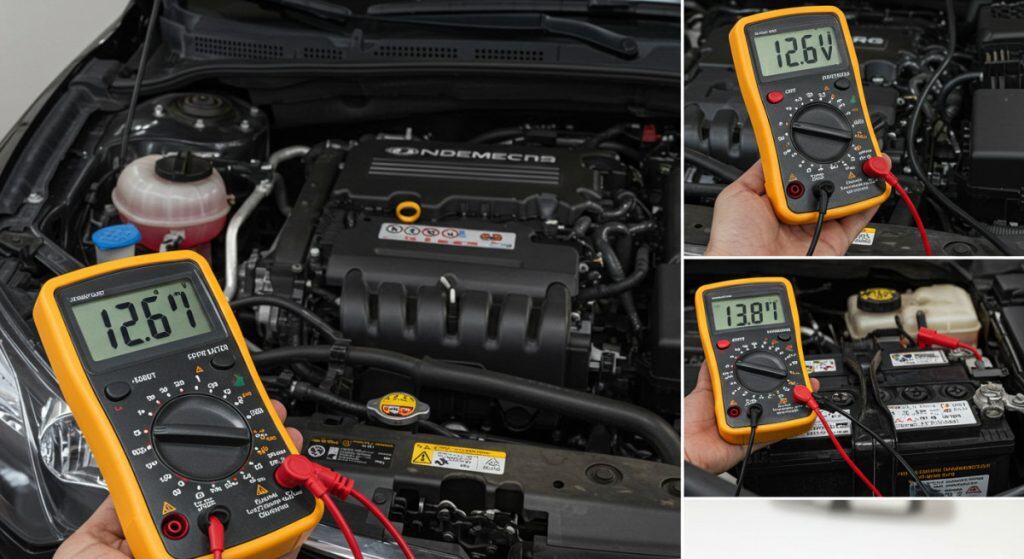
Battery and Alternator Test: With the car off, measure the battery (about 12.6V is full). Start the car — the reading should jump into the 13.8–14.7V range. Turn on lights and A/C; the voltage should stay above 13.5V. If it doesn’t, your alternator may not be charging properly.
Fuse Check: Instead of yanking fuses out one by one, put the multimeter in continuity mode and touch each side of the fuse. A beep means the fuse is intact.
Ground Strap Test: Switch to resistance (ohms) and measure between the negative battery terminal and bare engine metal. You want a very low number (close to 0). If it’s high, clean the strap or replace it.
Sensor Voltage Check: Back-probe a sensor like the throttle position sensor. As you slowly press the accelerator, the voltage should climb smoothly. If it jumps around or drops out, the sensor may be failing.
Setting Up Your Multimeter Safely
Every multimeter has two leads: black and red. Plug the black lead into COM and the red lead into the port marked VΩ. Select the mode you want on the dial. If your meter has “auto range,” let it pick for you.
A few safety notes:
- Always work with the car in park or neutral and wheels chocked.
- Keep clothing, hair, and jewelry away from moving engine parts.
- Never test resistance or continuity on a live, powered circuit — you can fry the meter.
Mistakes Beginners Should Avoid
- Using AC mode by accident. Cars use DC, so always pick the setting with the straight line (DC), not the wavy one (AC).
- Forgetting to change modes. Checking resistance on a live circuit in ohms mode can give nonsense readings.
- Assuming no beep = bad part. Sometimes connectors are dirty or probes aren’t making good contact. Always double-check.
When to Call in Backup
A multimeter can get you far, but if you’re finding wildly inconsistent voltages, repeated continuity failures, or readings that don’t match symptoms, you may need wiring diagrams or professional equipment like an oscilloscope. At that point, it’s best to let a shop step in.
FAQs
Can I damage my car with a multimeter?
Not if you use it correctly. Just avoid measuring resistance on a powered circuit.
Do I need an expensive one?
No. A $20–30 digital multimeter is plenty for beginners. More expensive models add features like auto-ranging and min/max recording.
Can a multimeter drain my battery?
Only if left connected for hours in resistance mode. Normal use won’t drain anything.
What’s the difference between resistance and continuity?
Continuity just says “yes or no” to whether the path is complete. Resistance gives you the actual number. Both are useful in different ways.
Final Thoughts
A multimeter is one of the simplest and most empowering tools you can add to your toolbox. Stick to the three core modes — voltage, resistance, and continuity — and you’ll be able to answer questions that stump a lot of car owners: Why is my battery light on? Is my battery healthy? Is my alternator charging? Is this fuse good? Is this wire broken?
Once you’ve mastered the basics, you’ll find yourself reaching for the multimeter before guessing or throwing parts at a problem. It’s your best friend in turning mystery lights and odd symptoms into clear, fixable answers.


