Skip to content

A neighbor asks if your future EV becomes “a giant toxic brick” after a few years. You have heard the rumors. Landfills. Fires. Maybe a second life somewhere far away? Short answer: old EV batteries do not go straight to the dump. Most enter one of three paths: repair or reuse in vehicles, second-life stationary storage, or material recycling. The share that ends up as true waste keeps shrinking.
Below, we will walk through how EV batteries age, what “old” really means, and where they go next. This is practical and US-focused, so you know what to expect as an owner or soon-to-be owner.
The Basics: What We Mean by “EV Batteries”
When people say EV batteries, they usually mean the big high-voltage pack under the floor that propels the car. It is made of modules, each filled with many lithium-ion cells. Today the most common chemistries are NMC, NCA, and LFP. There is also a 12-volt auxiliary battery in most EVs to power accessories and boot the car’s computers. That small battery behaves much like the one in a gasoline car.
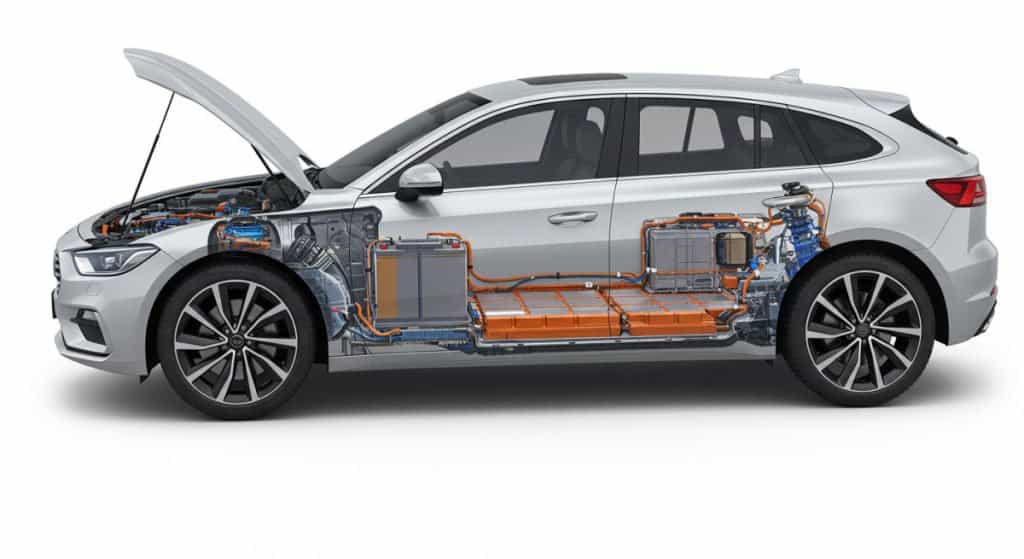
Two batteries. Two life cycles. One car. Keep that in mind.
When are EV Batteries “Old”?
Not when it hits a specific birthday. Old means the pack no longer meets its original job requirements such as range, peak power, or reliability. Automakers often warranty capacity for 8 years or 100,000 miles, and many packs hold up better than early skeptics predicted. Still, capacity slides over time.
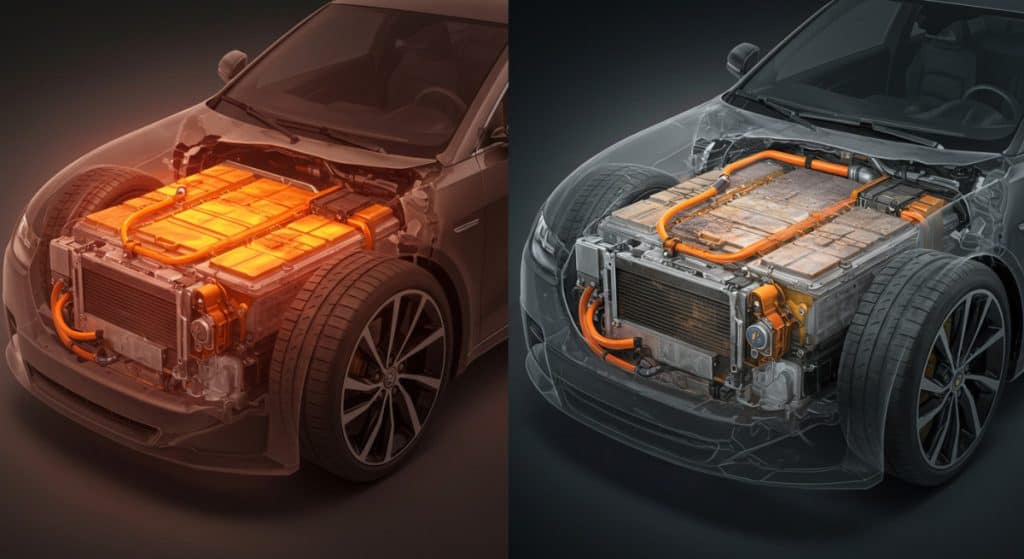
- Healthy: about 90 to 100 percent of original capacity. You barely notice any change.
- Aging but serviceable: about 70 to 90 percent. Range is down, yes, but the car remains practical for many commuters.
- End of first life in a car: typically around 70 to 80 percent capacity. Power delivery and fast-charge behavior may be less consistent. The car still moves, but it is not what it was.
That last band is where the pack often exits the automotive use case and enters one of the three post-automotive paths.
Path 1: Repair, Reconditioning, and Return to Service
Many “old” packs are not uniformly old. Think of a string of holiday lights. One weak segment can dim the set.
What happens:
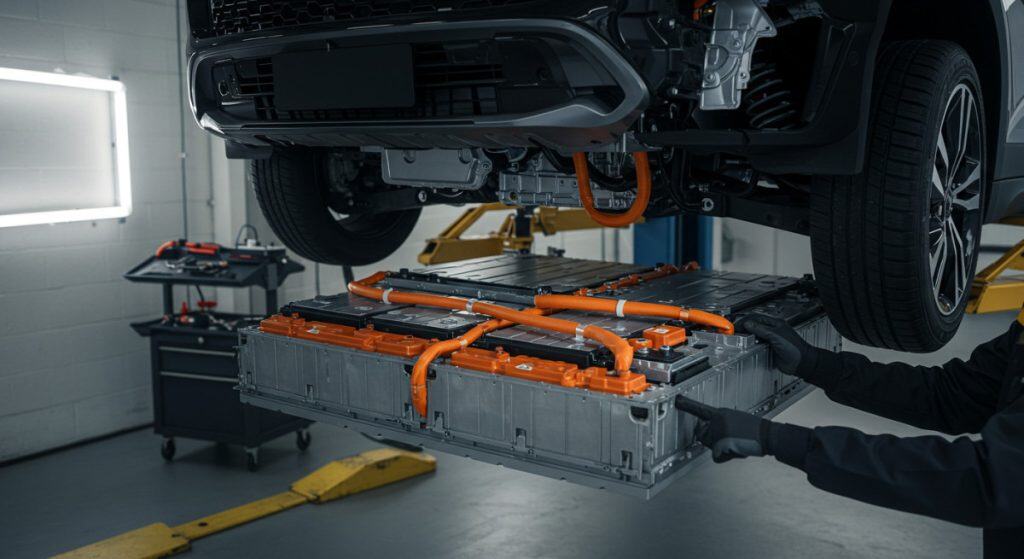
- Diagnosis. Technicians pull data and determine whether the issue is a module or two, or the entire pack
- Module swap. Bad modules are replaced with healthy ones, new or reconditioned, and the pack is balanced.
- Back to the car. The vehicle regains range and performance. The original pack lives on.
Pros
- Extends life with minimal material use.
- Often cheaper and faster than a full pack replacement.
Cons
- Requires access to compatible modules and skilled service.
- If the rest of the pack is aged, new issues may surface later.
I have seen owners get another few years this way. It is not glamorous and no one brags about a “module swap,” but it is efficient.
Path 2: Second-Life Stationary Energy Storage
When a pack cannot satisfy automotive demands, it may still be great at sitting still and storing energy. Stationary systems care less about power density and weight. They care about usable capacity, cycle life, and safety.
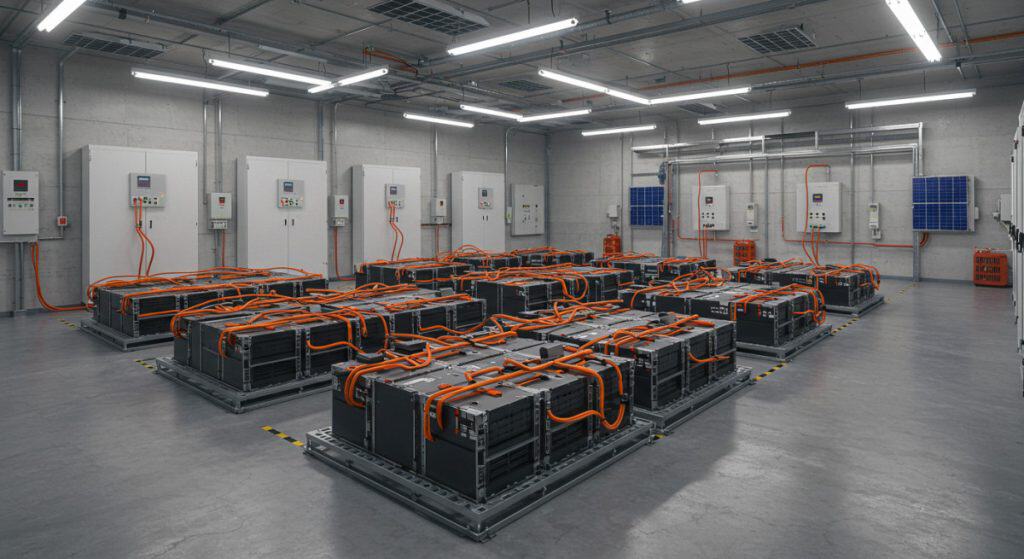
Typical second-life uses:
- Home or small-business storage. Store rooftop solar energy, shave peak grid rates, and provide backup power.
- Commercial or utility storage. Peak shaving, frequency regulation, demand charge reduction, and EV fast-charging buffers.
How the transition works:
- Packs are tested, graded, and re-binned by health.
- Modules are repackaged into new cabinets with appropriate battery management systems (BMS), cooling, and safety enclosures.
- Software monitors the state of charge, temperature, and faults in real-time.
Why it makes sense:
- A pack at 75 percent capacity can have thousands of useful cycles left, especially at gentle charge and discharge rates.
- Stationary duty can be kinder. Narrower state-of-charge windows and lower C-rates extend life further.
Caveats:
- Not all packs are economically viable for second life when you add logistics, testing cost, and safety certification.
- Standardization is improving but not perfect. Integration still takes engineering effort.
Do all old EV packs get second lives? No. Many do. Others skip ahead to recycling. The split varies by chemistry, condition, and market economics at the time.
Path 3: Recycling That Actually Recovers Materials
When repair does not pencil out and second life is not a fit, recycling takes the stage. Modern facilities are not just “smelting.” Processes have become more sophisticated. Three broad approaches exist, often combined:
- Mechanical, or shred and sort. Disassembles the pack, shreds modules, and separates plastics, aluminum, copper, and a black mass powder rich in nickel, cobalt, lithium, manganese, and graphite.
- Pyrometallurgical, or high temperature. Melts materials to recover metals like nickel, cobalt, and copper. It is simple and robust, but can lose some lithium to slag unless followed by additional steps.
- Hydrometallurgical, or wet chemistry. Leaches metals from black mass using aqueous solutions, which enables higher lithium recovery and purer outputs. Temperatures are lower, chemistry does the heavy lifting.
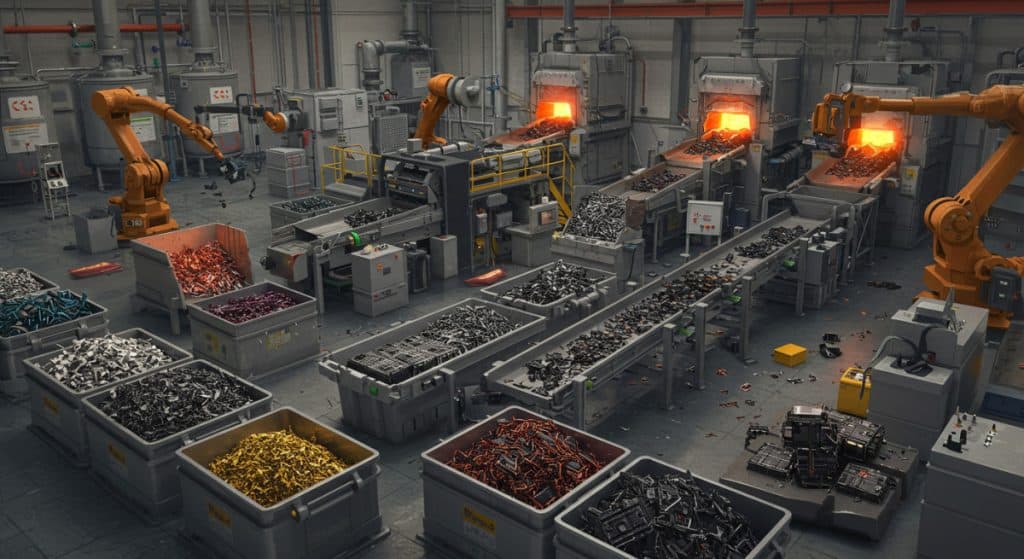
A growing number of US facilities, along with automaker partnerships, are pushing toward closed-loop material flows. That means recovered metals go back into new cathodes. Is this already happening at scale? Yes, more each year. Could it be better? Also yes. Recovery rates and costs keep improving.
Safety note: Transportation and preprocessing are tightly regulated. High-voltage packs are shipped in compliant containers under state and federal guidance. Households should not place lithium batteries in trash or curbside recycling and should isolate terminals or bag cells before drop-off.
What About Fires?
You have seen the viral videos. Thermal events are rare on a per-mile basis, yet not zero. Most end-of-life handling is designed to avoid the abuse conditions that trigger runaway, such as over-discharge, crush damage, or short circuits. Facilities use insulated tools, controlled discharge, and monitoring to keep conditions stable.
Could an incident happen? It could. That is exactly why responsible logistics and trained handlers are a must.
Where US Owners Fit In
You will not personally palletize a 1,000 pound pack. Still, a few owner decisions shape the battery’s future.
- Use the warranty and official channels. If range nosedives or the car throws high-voltage battery faults, start with the dealer or an authorized service network. They will route packs to the correct afterlife, whether repair, second life, or recycling.
- Avoid deep storage neglect. If you plan to park the EV for months, store it around 40 to 60 percent state of charge and check in periodically. Extreme heat is the enemy. Shade and ventilation help.
- Keep the 12-volt battery alive. The small battery still matters. It boots the car and stabilizes systems. A weak 12-volt can masquerade as bigger problems.
A useful tool for the 12-volt system
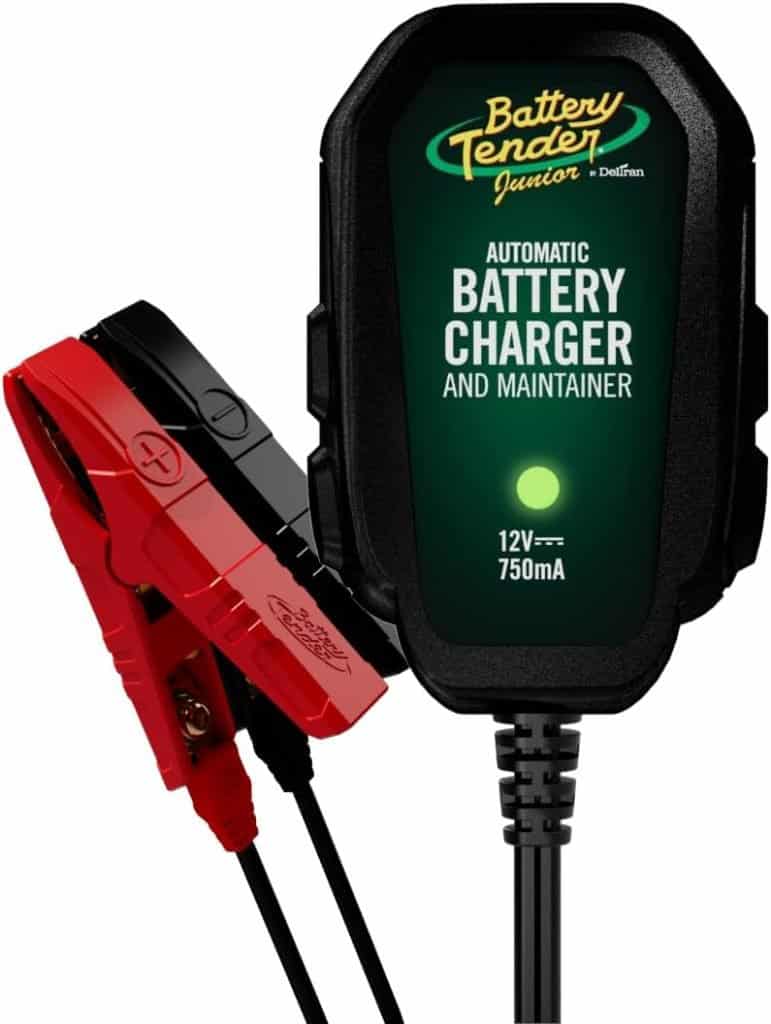
If the car will sit for a while, for example you are traveling or the EV is a second vehicle, a maintainer keeps the 12-volt battery from quietly dying. A solid option is the Battery Tender Junior 12V, 750 mA Charger and Maintainer. It is compact, smart, and gentle on lead-acid batteries.
What Determines the Path: A Quick Decision Flow
- Pack health at or above about 80 percent and a localized fault leads to repair or a module swap, then back into the car.
- Pack health around 70 to 80 percent, uniform aging, and stable behavior can become a second-life stationary storage candidate.
- Pack health below about 70 percent, or damage, or unfavorable economics usually points to material recycling.
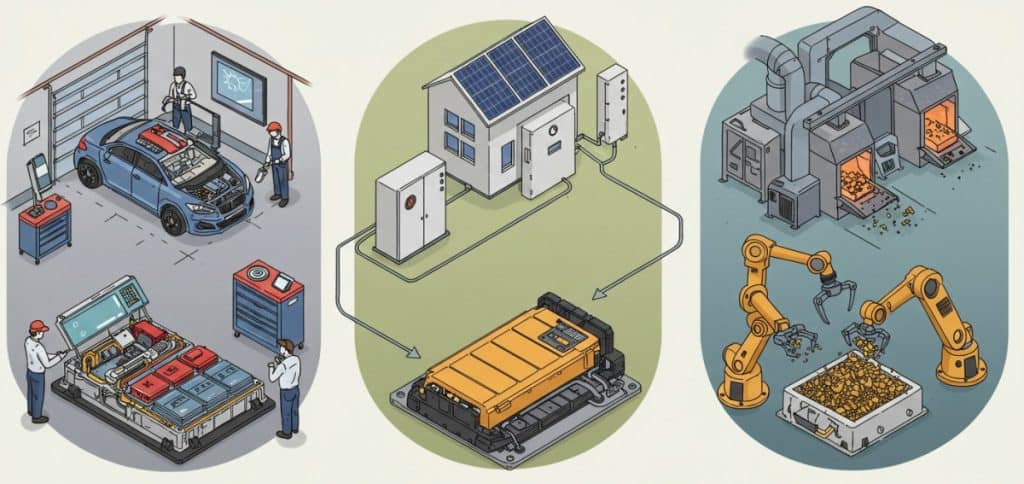
There is wiggle room. A well-cooled LFP pack at 72 percent might shine in a stationary system. A crash-damaged pack with good capacity might go straight to recycling for safety reasons. Reality is messy, and the industry builds guardrails around that mess.
Economics: Why The Market Cares
- Residual value of materials. Nickel and cobalt are valuable. Lithium recovery is improving. Even LFP packs, which have less nickel and cobalt, can be worth recycling for lithium, copper, and aluminum as processes get cheaper.
- Producer responsibility and warranties. Automakers and recyclers are aligning around traceability and recovery targets that feed new battery production.
- Second-life demand. Solar plus storage continues to grow. Used EV module banks can compete on cost if testing and integration are efficient.
Will second life always beat recycling? Not necessarily. Sometimes direct-to-recycling delivers more value because it shortens the loop and feeds new battery production. Other times, squeezing another 5 to 10 years of stationary service from a pack is the better play. It depends on chemistry, labor, logistics, and metal prices. Those variables move.
Myths vs. Reality
- Myth: Most old EV batteries end up in landfills.
Reality: Packs are too valuable and too regulated to throw away. There is money in the metals and well-defined channels to capture them. - Myth: Recycling cannot recover lithium.
Reality: Early smelting alone struggled with lithium. Modern hydrometallurgy recovers it at meaningful rates. - Myth: Second life is unsafe.
Reality: Properly engineered systems use conservative operating windows and robust BMS hardware and software. Sloppy DIY is where risk creeps in. - Myth: EV batteries die suddenly.
Reality: Capacity fades gradually. Sudden failure usually points to a defect, damage, or a non-traction issue such as the 12-volt battery.
Owner FAQ
How long do EV batteries last?
Many last well past the warranty window with moderate capacity loss. Climate, fast-charging habits, and thermal management matter.
Can I choose second life for my pack?
Direct consumer choice is limited. Most flows go through automakers or certified recyclers who assess and allocate packs. You can influence outcomes by using official channels and not selling damaged components online.
Is LFP better for second life?
Often yes. LFP tolerates more cycles and prefers mid-SOC operation. Those traits align with stationary use. Energy density is lower, which matters less off-vehicle.
What about solid-state batteries in the future?
Promises include higher energy density and potentially simpler recycling streams. Timelines and real-world behavior are still developing. We will adapt as facts arrive.
Can I maintain my pack’s health?
Avoid chronic 100 percent daily charges and frequent deep discharges. Keep the car as cool as is practical. Update software. BMS improvements can refine charge windows and longevity.
A Note on the 12-Volt Battery
Even in EVs, a weak 12-volt battery is a common cause of “car will not start” headaches. If the vehicle sits, a maintainer helps. Again, something like the Battery Tender Junior 12V, 750 mA is a simple fix for an annoying problem. Use the included quick-connects, follow polarity carefully, and route cables cleanly. It is small and perhaps boring, but it prevents larger support calls.
This bears repeating one more time for safety: maintainers are for the 12-volt system only.
The Big Picture
As the US EV fleet grows, so does the river of retired EV batteries. That sounds scary until you notice the loop closing. Repair keeps good packs on the road. Second-life storage supports renewables and trims grid peaks. Recycling recovers metals for the next generation of EV batteries. The landfill story makes great clickbait and poor engineering.
If you are considering an EV, do not let “what happens to the battery” be the deal-breaker. Packs rarely vanish into waste. They cascade through roles, from car, to storage, to materials, and each step is getting cleaner and more economical. As an owner, use official channels for service, store the car sensibly, and keep that humble 12-volt healthy. The rest is infrastructure, and it is improving faster than most people think.