 Skip to content

The Button Nobody Talks About
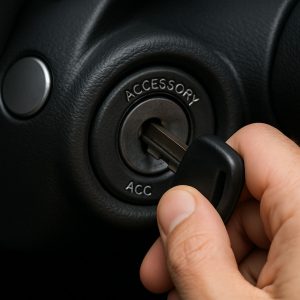
Most people notice “Accessory” or “ACC” on their ignition or push-start button and then just ignore it completely. It’s there, it exists, but nobody really mentions what it’s for.
Many drivers have no idea what it actually does. Just twisting the key until the engine starts feels like enough for most people. Turn key, car goes vroom, that’s all that seems necessary.
But Accessory Mode is actually pretty useful once understood. Nothing complicated, nothing revolutionary, but one of those small features that make car ownership a little more convenient.
So… What Actually Is Accessory Mode?
In simple terms, Accessory Mode (often abbreviated as “ACC” on the ignition switch or dashboard) powers some of the car’s electrical systems without turning on the engine. The radio will work, the owner’s windows function, and usually the charging ports too, but the engine stays off.
The exact features depend a little on the car, which can be confusing at first. Some vehicles let you use almost everything electrical in Accessory Mode, while others limit you to just entertainment systems. Luxury cars tend to have more features than economy models.
The whole point is saving fuel and reducing engine wear when just electricity is needed, not propulsion. It’s a middle ground between completely off and fully running.
How to Activate It (It’s Easier Than It Sounds)
For most cars with traditional keys, simply turn the key halfway, right before the position that would start the engine. In push-button start vehicles, it’s usually pressing the start button once without a foot on the brake pedal.
Some newer cars handle it differently, which can be confusing. Some Hyundai models require two button presses without the brake, while many Toyota vehicles just need one. Not exactly standardized.
Checking the owner’s manual provides the exact procedure for each specific car, though most people rarely read these manuals. They tend to gather dust in the glove compartment until something breaks.
ACC vs Ignition On
Many drivers confuse Accessory Mode (ACC) with the “Ignition On” position, but they serve different purposes:

Accessory Mode (ACC):
- Powers only electrical accessories
- Does not activate the engine control unit or fuel system
- Uses less battery power
- Perfect for using electronics briefly while parked
- Dashboard lights remain mostly off
Ignition On:
- Activates all electrical systems, including engine computers
- Powers dashboard warning lights for system checks
- Primes the fuel system and readies the engine for starting
- Consumes more battery power
- Often required for certain diagnostic functions
The key difference is that Ignition On prepares all vehicle systems as if you’re about to drive, while ACC only powers convenience features. Using ACC instead of Ignition On when possible helps preserve battery life and reduces unnecessary wear on electrical components.
When You Should Use Accessory Mode
There are several situations where Accessory Mode makes perfect sense:
- When sitting in a parking lot, waiting for someone but wanting to listen to music
- Needing to charge a phone without wasting gas
- During drive-in movies (though not for the whole movie)
- When wanting to roll the windows up or down while parked
- While eating lunch in the car, and wanting some entertainment
It’s especially great on mild days when full AC or heating isn’t necessary. It works perfectly for those 10-15 minute waits when a friend texts “be there in a minute,” but actually means “haven’t left the apartment yet.”
Times You Probably Shouldn’t Use It
Accessory Mode isn’t meant for everything, and there are definitely times to avoid it:
- During longer waits (over 30 minutes), it slowly drains the battery
- When running power-hungry features like high-volume stereo with subwoofers
- In extreme temperatures, when climate control might be needed
- If the battery is already older or weaker than ideal
Some drivers have learned the hard way after draining batteries listening to podcasts while waiting for deliveries. Calling roadside assistance can be both embarrassing and time-consuming.
As a general rule, if a wait might be longer than 20-30 minutes, starting the engine occasionally to recharge the battery is wise. Better safe than sorry.
Common Misconceptions About Accessory Mode
There are a few things people get wrong about Accessory Mode:

First, it’s not meant for hours-long tailgating or camping. A car battery has limited capacity when the engine isn’t running to recharge it.
Second, yes, it does drain the battery, just not as quickly as having headlights and other systems on. The drain is real, just slower.
Some people say never use it, others swear by it. Like a lot of car advice, the truth’s somewhere in the middle. It’s a useful feature when used appropriately, not some magical free energy setting.
Another misconception is that it’s the same as idling. It’s actually much better for both the car and the environment since the engine isn’t running at all.
Does Accessory Mode Work Differently in Electric Cars?
Short answer: Sort of.
Electric vehicles don’t have a traditional ignition system because there is no combustion engine to start. But most still offer an equivalent to Accessory Mode that powers the infotainment and climate controls without engaging the drive systems.
Every EV brand handles it differently, and even models from the same manufacturer can vary depending on the year they were produced. Some call it “Accessory Mode” to maintain familiarity, others use terms like “Energy Mode” or “Service Mode.”
The basic concept stays consistent, though; it’s about using some electrical features without drawing too heavily from the main propulsion battery. In EVs, it’s less about saving fuel and more about preserving range.
Small Feature, Big Convenience
Accessory Mode isn’t life-changing technology. It won’t revolutionize the driving experience or significantly increase a car’s resale value. But it’s one of those small conveniences that, once people start using it, they wonder how they overlooked it for so long.
Next time waiting in the car, giving it a shot might be worthwhile. Just keep an eye on the battery. And keep jumper cables in the trunk in case that podcast queue gets too entertaining.
It’s these little features, the ones nobody bothers to explain, that sometimes make the biggest difference in day-to-day car ownership.
Related Resources:
- https://fordcmaxhybridforum.com/topic/808-how-to-put-car-into-accessory-mode
- https://piketransit.com/how-to-put-car-in-accessory-mode/


