 Skip to content


One of the worst feelings is getting your car back after paying for a repair or service, only to notice something that still does not seem right.
If you just had a wheel alignment and your steering wheel is visibly crooked while you are driving straight, you are justified in questioning the result.
That does not automatically mean the technician made a mistake. Road crown, tire pull, worn steering or suspension components, and other conditions can affect what you feel. But a steering wheel that remains noticeably off-center immediately after an alignment deserves an explanation.
Quick Answer:
Yes. Your steering wheel should normally be centered when the vehicle travels straight on a reasonably level road after a properly completed alignment, within the vehicle’s allowable tolerance. If it remains visibly off-center immediately after the service, you have a legitimate reason to ask the shop to recheck the alignment. Just make sure you distinguish an off-center steering wheel from an actual vehicle pull, because they are not the same problem.
You do not need to apply a universal steering-wheel offset number yourself. Some manufacturer procedures define their own centering tolerance, so if the offset is persistent and repeatable, the shop can check it against the specification that applies to your vehicle.
What to Check Right After an Alignment
Before deciding that the alignment is wrong, pay attention to exactly what the vehicle is doing.
Pay attention to the steering-wheel position on the first safe drive after the alignment. If it is already visibly off-center before any later pothole, curb strike, or other impact, that timing is useful information to give the shop.
Choose a straight, reasonably level road in safe driving conditions.
Keep normal control of the steering wheel. You do not need to let go of it to test the alignment.
While maintaining a straight path, notice where the steering-wheel spokes sit.
Ask yourself:
- Does the car travel straight while the steering wheel remains visibly turned left or right?
- Does the steering wheel look centered, but the vehicle consistently wants to move toward one side?
- Are both things happening?
- Does the behavior change significantly on another road?
- Did the problem appear immediately after the alignment, or only after a later pothole, curb strike, or other event?
Avoid judging the alignment from one heavily crowned road, strong crosswind, rough surface, or road with deep grooves.
Roads are often slightly sloped for drainage. That road crown can make a vehicle drift and require a small amount of steering input even when the alignment itself is acceptable.
If possible, compare how the vehicle behaves on another reasonably level road before deciding that the steering wheel itself is consistently off-center.
Off-Center Steering Wheel vs. Vehicle Pull

These two complaints are easy to mix up, but they describe different things.
Steering Wheel Is Off-Center but the Car Tracks Straight
This is the clearest version of a crooked steering wheel after an alignment.
The vehicle travels in a straight line, but you need to hold the steering wheel slightly left or right instead of having it visually centered.
Toyota describes steering-wheel off-center in essentially this way: the vehicle travels straight, but the steering wheel is not pointed straight ahead.
If this started immediately after the alignment and repeats on suitable roads, take it back and ask the shop to recheck the steering-wheel centering and alignment.
Steering Wheel Is Centered but the Car Pulls
A vehicle pull is different.
The steering wheel may appear straight, but the vehicle consistently tends to move toward one side.
Alignment can contribute to a pull, but it is not the only possible cause.
Other possibilities include:
- road crown
- tire pressure differences
- tire conicity or another tire-related pull
- camber or caster differences
- damaged tires or wheels
- worn or bent steering or suspension components
- previous impact damage
Tire conicity refers to a tire generating a lateral force that can make the vehicle tend toward one side. That means a car pulling after an alignment does not automatically prove that steering-wheel centering or the alignment adjustment itself is the sole problem.
The Car Pulls and the Steering Wheel Is Off-Center
If you have both symptoms, tell the shop about both.
Do not describe the problem only as a crooked steering wheel if the vehicle also consistently pulls.
The pull may need to be diagnosed along with the steering-wheel centering. In some manufacturer procedures, the pull is addressed first because correcting its cause can change how the steering-wheel position appears afterward.
Why Steering-Wheel Centering Is Part of an Alignment

A modern wheel alignment measures the positions and angles of the wheels and compares them with specifications for the vehicle.
Depending on the equipment, alignment systems can use digital cameras with wheel-mounted targets or other sensors to measure that geometry.
The primary alignment angles you will commonly hear about are:
- toe
- camber
- caster
Rear thrust angle and steer-ahead can also matter when diagnosing straight tracking and steering-wheel centering.
The steering wheel itself is not another alignment angle. Its centered position is part of setting up and verifying the vehicle’s straight-ahead condition.
Toe
Toe describes whether the wheels point slightly inward or outward relative to each other when viewed from above.
Vehicles have specified toe values and tolerances, so the goal is not necessarily to make every wheel mathematically parallel.
Toe is especially relevant to a crooked steering wheel because the steering wheel establishes the straight-ahead reference while front toe is adjusted.
Depending on the vehicle and alignment equipment, the technician may physically hold or reference the steering wheel in that straight-ahead position with a centering tool while the toe adjustment is made.
Front toe is adjusted through the steering linkage, including the tie rods.
If the side-to-side adjustment is not established correctly, it is possible to end up with a steering wheel that sits off-center even though some displayed alignment measurements appear acceptable.
Correcting that condition generally involves the appropriate steering-linkage and toe adjustments rather than simply assuming the steering wheel itself needs to be physically repositioned.
Camber
Camber describes the inward or outward tilt of the wheel when viewed from the front of the vehicle.
The correct camber is whatever the manufacturer specifies for that vehicle. It is not universally zero or perfectly vertical.
Incorrect camber can contribute to abnormal tire wear, while side-to-side camber differences can also contribute to a vehicle pulling.
That makes camber relevant to a pulling complaint, but it does not mean every camber reading outside a visually vertical position is wrong.
Caster
Caster describes the forward or backward tilt of the steering axis when viewed from the side.
Like camber, the correct caster value is vehicle-specific.
Caster contributes to directional stability and the tendency of the steering to return toward center after a turn.
A significant side-to-side caster difference can contribute to vehicle pull, but caster should not be treated as the automatic explanation for a visibly crooked steering wheel.
Thrust Angle
Rear-wheel geometry creates a direction of travel, sometimes described as the vehicle’s thrust line.
Thrust angle compares that direction with the vehicle’s centerline.
If the rear thrust angle is excessive, the vehicle can effectively travel along a path that contributes to an off-center steering-wheel position.
That is why a steering-wheel-centering complaint is not always limited to front toe.
Why the Steering Wheel Can Still Look Crooked
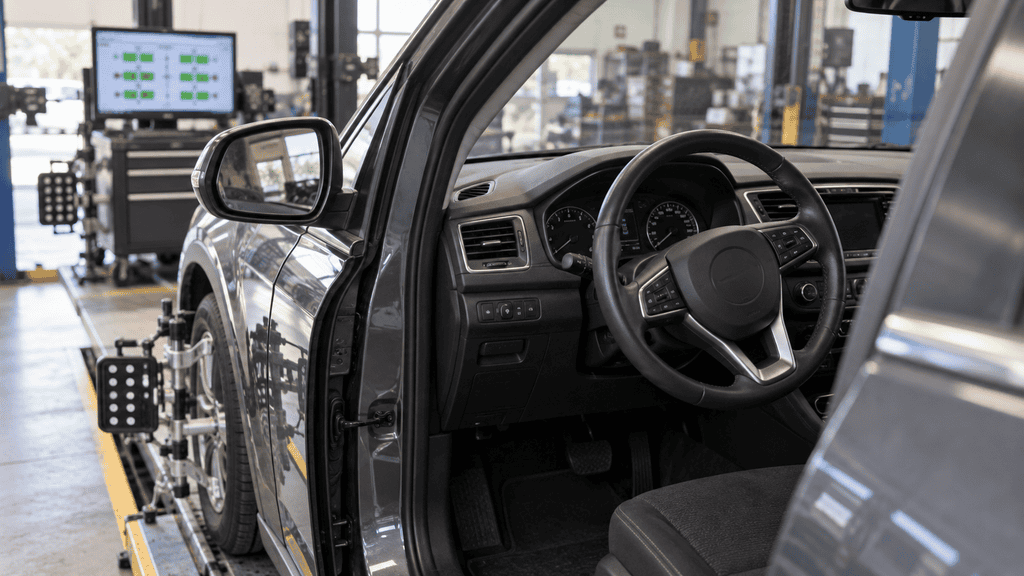
A steering wheel can remain off-center even when an alignment printout contains several measurements shown as being within specification.
That does not necessarily mean the entire alignment is badly wrong.
Steering-wheel center, steer-ahead, the balance of the left and right steering adjustments, and rear thrust geometry can still matter.
For example, unequal tie-rod adjustment can affect the steering wheel’s straight-ahead position.
This is also why a generic response of “everything is green on the machine” does not automatically settle a persistent steering-wheel-centering complaint.
If the car repeatedly tracks straight but the steering wheel remains visibly crooked, the actual centering condition should still be checked.
When to Take It Back to the Alignment Shop
If the steering wheel was centered before the alignment but became visibly off-center immediately afterward, return to the shop promptly.
You do not need to accuse the technician of doing a bad alignment.
Give them a precise description of what you observed.
You can say:
“My steering wheel is still visibly off-center when the car tracks straight on a reasonably level road. Can you recheck steering-wheel centering, toe/steer-ahead, the relevant rear/thrust-angle readings, and the before-and-after alignment measurements?”
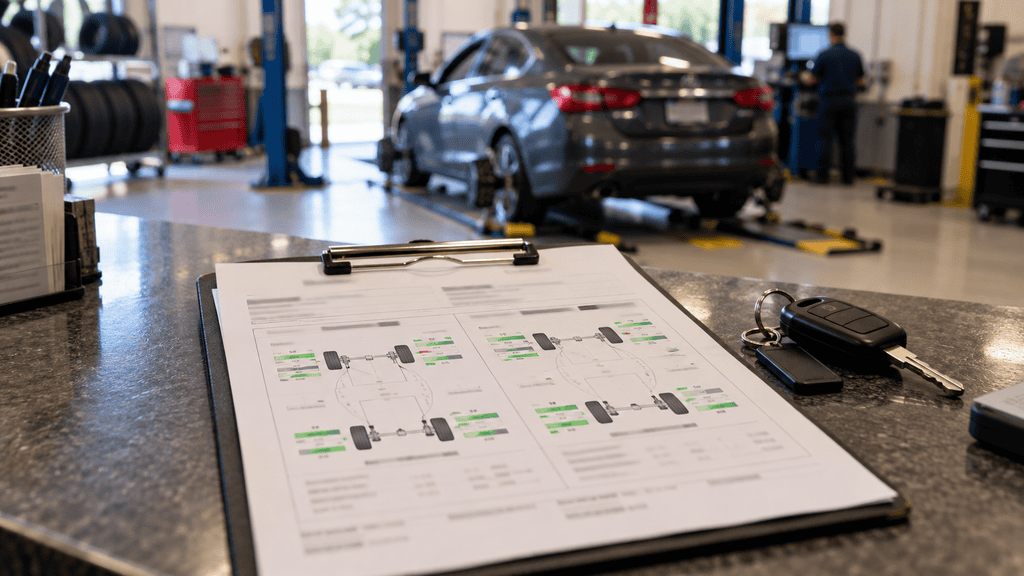
If you received a before-and-after alignment printout, bring it with you. If you did not receive one, ask whether one is available.
The printout can help show what was measured before and after the service, but a page full of readings shown as “within spec” does not by itself prove that every part of the final driving result is correct.
If you are asking about rear thrust angle, check the alignment printout or invoice to see whether rear measurements were included. Some alignment procedures measure only the front axle, while thrust-line or four-wheel procedures include rear geometry. If your report does not show rear measurements, ask the shop what was actually measured before assuming the rear thrust angle was checked.
The goal is not to start a fight with the shop. It is to give them a repeatable complaint they can verify.
Shop warranties and correction policies vary, so do not assume every recheck or adjustment will automatically be free. But if the steering wheel became visibly off-center immediately after the service, it is reasonable to ask the original shop to inspect the result.
If the Problem Appeared Later
Timing matters.

If the steering wheel was centered after the alignment and only became crooked days or weeks later, something may have changed after the service.
Pothole or Curb Impact
A significant pothole, curb strike, or similar impact can alter wheel alignment or damage a:
- tire
- wheel
- steering component
- suspension component
That does not mean every pothole automatically knocks the car out of alignment.
But if the steering behavior changed immediately after a hard impact, tell the technician about that event rather than assuming the earlier alignment was simply performed incorrectly.
Uneven Tire Wear
Uneven tire wear can be a reason to have the alignment and surrounding components inspected.
However, alignment is not the only possible cause.
Tire pressure problems, damaged tires, and worn steering or suspension components can also contribute to unusual wear.
New Tires
Installing new tires is a useful opportunity to check alignment, especially if the old tires wore unevenly.
That does not mean mounting new or winter tires automatically requires an alignment adjustment every time.
Steering or Suspension Repairs
Alignment should also be considered when steering or suspension work affects components or geometry involved in wheel position.
The exact requirement depends on what was repaired and the vehicle’s service procedure.
Lowered or Modified Suspension
Changing the vehicle’s ride height can change suspension and alignment geometry.
If the vehicle has been lowered or otherwise had its suspension height changed, its alignment should be checked and set appropriately for that configuration.
If you are considering this type of modification, MotorHills also has a guide to reasons why people lower a car’s suspension.
Steering Looseness or Instability Is More Than a Simple Alignment Complaint
A crooked steering wheel and excessive steering play are not the same problem.
If you notice:
- unusual looseness in the steering
- clunking or other abnormal noises
- delayed or unpredictable steering response
- significant vibration
- obvious instability
do not assume another alignment adjustment is all the vehicle needs.
Worn, loose, bent, or damaged steering and suspension components may need to be inspected first.
If steering control feels unsafe or unpredictable, do not continue driving simply to perform more alignment observations.
That is different from a steering wheel that is merely a little off-center while the vehicle otherwise tracks normally.
Some Vehicles Need Electronic Reset or Calibration Procedures
Modern vehicles can use steering-angle sensors, electric power steering, stability-control systems, and driver-assistance features that depend on knowing the vehicle’s straight-ahead steering position.

Some vehicles require a steering-angle sensor reset or another vehicle-specific procedure after certain alignment work.
That does not mean every alignment requires a steering-angle reset or ADAS calibration.
The correct requirement comes from the service information for the particular vehicle.
If the crooked steering wheel is accompanied by a steering, ESC, or driver-assistance warning, or the steering assist behaves abnormally after the service, mention that to the shop rather than treating the problem as a simple visual centering issue.
Should Your Steering Wheel Be Straight After an Alignment?
Normally, yes.
When your vehicle travels straight on a reasonably level road after a properly completed alignment, the steering wheel should normally sit centered within the tolerance specified for that vehicle.
If it remains visibly and consistently off-center immediately after the service, you have a legitimate reason to return and ask the shop to recheck the result.
Just make sure you describe the actual symptom.
A car that tracks straight with a crooked steering wheel is different from a car that pulls with a centered wheel. Road crown and tires can influence pulling. A later pothole or curb impact changes the story. Excessive steering looseness or instability can point to a mechanical problem beyond alignment.
You paid for the vehicle to leave the alignment service behaving correctly. If the wheel remains visibly off-center under suitable driving conditions, asking the shop to verify the centering and alignment readings is reasonable.
External Resources
- Toyota / NHTSA: Vehicle Pull, Steering Wheel Off Center, and Alignment Best Practices
- Infiniti / NHTSA: Diagnosis of Vehicle Pull and/or Steering Wheel Off-Center
- Hunter Engineering: Standard Alignment Systems
- Michelin: Wheel Alignment and Balancing
- Hunter Engineering: Vehicle-Specific Steering Reset and ADAS Procedures





Well, thanks for proving that a total wheel realignment must be done if the treads on our tires show ununiform wear and tear marks. That might be just what my daughter has been experiencing with her car over the past few days now when she drives to work. I’ll make sure she seeks professional aid so the problem can be resolved the right way.
An alignment along with a tire rotation at oil change intervals really does help have even tread wear on all four tires.
The biggest issue is that mechanics often do not clamp the steering wheel in the straight forward position before carrying out adjustments. This means that when you drive the car then the steering wheel is misaligned. It is pure laziness. What’s worse is that when they are challenged on it they will try to make out that you are being over fussy.
A steering assist is reduced, drive with care light came on after my alignment as well as my steering wheel being crooked. The mechanics said they will have to cut some of my tie rod to fix the steering wheel in order for the tie rod to have room to move and be adjusted. Which does not make sense to me the more I do research and try to use my own imagination. Is there something I am missing? Also, I took it back 2 days later they said they’ll fix it, on my way home I merge on a roundabout to get to the highway I feel my steering wheel lose control and suddenly I press the gas pedal and my truck won’t move. Eventually I take it right back explaining what just happened. Told them to fix my steering wheel who cares if it messes with the alignment I’m taking my truck how it was and to another shop. Should I ask for my money?
If they possibly made it worse and are trying to modify the tie rod to make it work, I wouldn’t let them touch the vehicle any further and request a refund I would take it to another shop that has prior experience working on your specific truck. Each vehicle presents its own challenges when it comes to finding the right solution and what the right method should be when it comes to alignment.
My recommendation would be to not let them cut the tie rod. As for the steering wheel assist, there is a control module responsible for that. I would recommend finding a shop that not only does alignment but has the factory Ford OBDII scan tool in order to communicate with the steering wheel assist control module and find out why your vehicle suddenly lost control. If it’s having an issue that dangerous, it’s probably best to get it towed to the next reputable shop.