 Skip to content

If you tow a conventional trailer, tongue weight is one of the most important numbers in the whole setup. In simple terms, it is the downward force the trailer puts on the hitch ball. For most conventional bumper-pull trailers, the normal target is about 10% to 15% of the trailer’s loaded weight, not the empty brochure number. So if your trailer weighs 5,000 pounds loaded for the trip, a normal tongue-weight target is about 500 to 750 pounds.
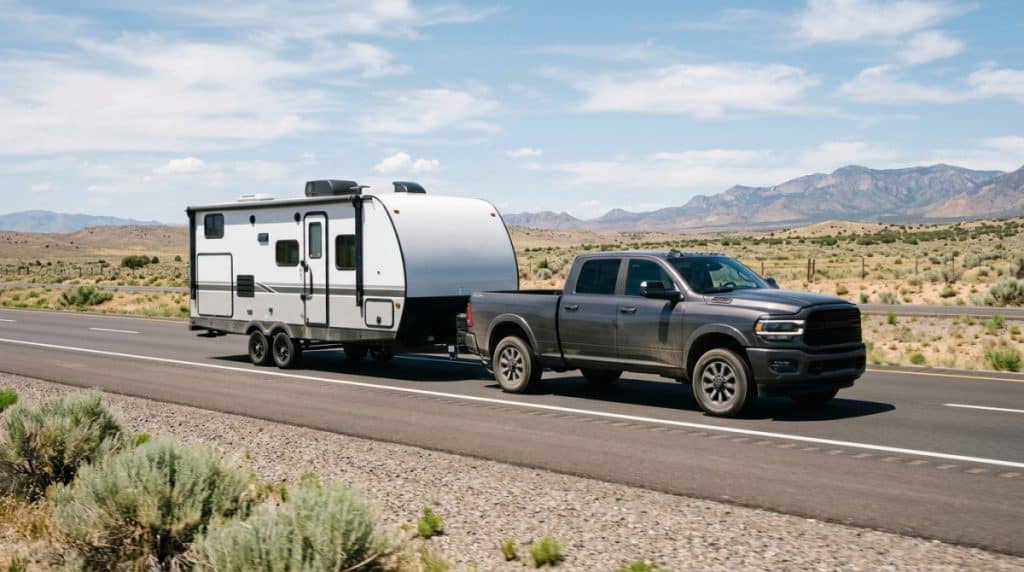
That number matters because both extremes can make towing ugly fast. Too little tongue weight can make a trailer sway or fishtail. Too much tongue weight can overload the rear of the tow vehicle, lighten the steering feel, and eat up payload faster than a lot of people realize. And yes, tongue weight counts against payload. That is one reason a truck or SUV can technically have enough tow rating for a trailer on paper and still be a bad match in the real world.
The short version is this: tongue weight can make a trailer feel stable or sketchy, even when the trailer itself looks fine on paper.
What tongue weight actually means
Tongue weight is the vertical load the trailer coupler puts on the hitch ball.
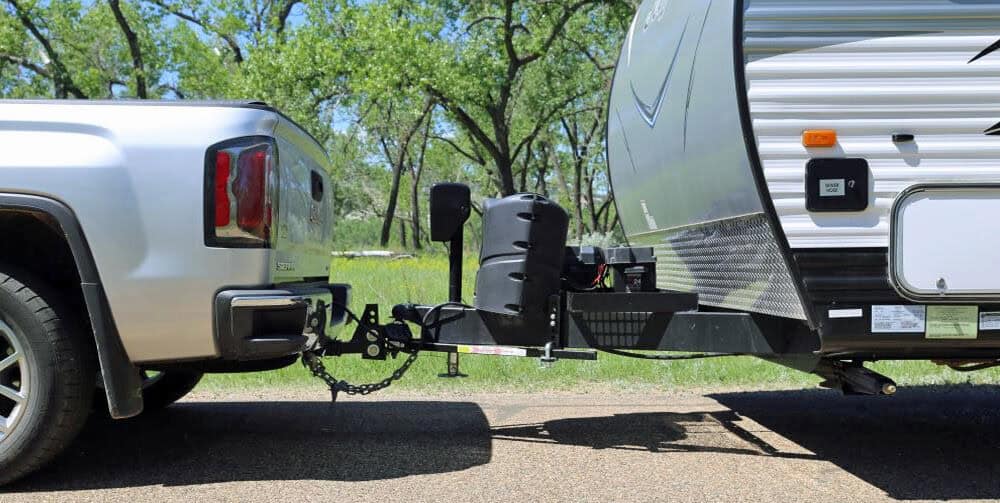
That is the clean definition. On a normal bumper-pull trailer, it is the trailer pressing down on the back of the tow vehicle through the hitch. That load affects stability, rear-suspension squat, steering feel, braking, payload use, and whether the whole rig is actually within limits.
This is also where the wording gets messy, because people use a few terms loosely.
For conventional bumper-pull trailers, these often get used casually to mean basically the same idea:
- tongue weight
- hitch weight
- TW
In everyday towing talk, they are usually describing the same basic force at the hitch ball.
But pin weight is different technically. Pin weight, or king pin weight, usually refers to fifth-wheel or gooseneck trailers, where the load sits in the bed area instead of on a rear hitch ball. Those setups typically run a higher percentage, usually somewhere around 15% to 25%, which is why they should not be lumped into the same bucket as normal bumper-pull tongue weight.
So for this article:
- tongue weight / hitch weight / TW = the usual language for conventional bumper-pull trailers
- pin weight / king pin weight = usually a fifth-wheel or gooseneck term with different expected numbers
That distinction is worth clearing up early, because a lot of people search those terms like they all mean the exact same thing.
Why tongue weight matters so much
A trailer can be “within tow rating” and still tow badly if tongue weight is wrong.
That is the part a lot of people miss.
Too little tongue weight
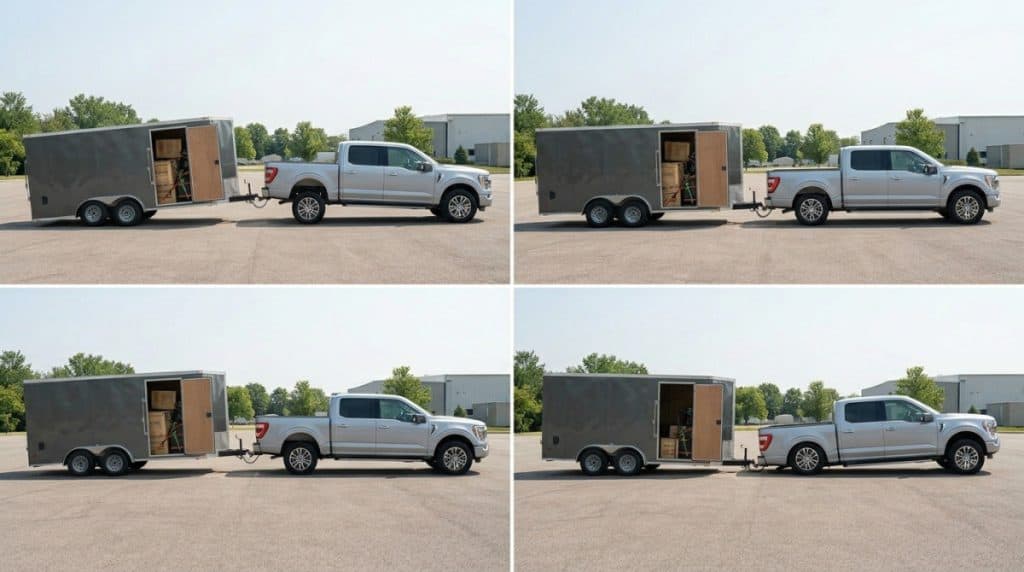
If there is not enough load pushing down on the hitch, the trailer can get unstable. NHTSA’s towing safety guide warns that too little tongue weight can cause trailer sway. That is where you get the trailer wandering, fishtailing, or feeling twitchy at highway speed, especially with wind, passing trucks, rough pavement, or abrupt steering input.
Too little tongue weight usually means too much of the trailer’s load is biased toward the rear. That makes the trailer more willing to pivot and oscillate instead of tracking cleanly behind the tow vehicle.
Too much tongue weight
If there is too much downward load on the hitch, the back of the tow vehicle can squat hard. NHTSA also warns that too much tongue weight can take too much weight off the front axle, which makes the tow vehicle less responsive to steering. Airstream says excessive hitch weight can also hurt traction and stopping. In real life, that means light steering feel, less confidence in emergency maneuvers, and a faster path to overloading payload, the rear axle, or the hitch itself.
A good fast takeaway is this:
- Too light = sway risk
- Too heavy = overloaded rear end, worse steering, less margin
Both are bad. One feels sketchy and loose. The other can feel planted at first but still be overloaded and wrong.
That is why tongue weight is not just a trailer number. It directly affects:
- trailer stability
- suspension squat
- steering feel
- braking balance
- payload use
- hitch and receiver stress
What number should you actually aim for?
For most conventional bumper-pull trailers, the normal target is about 10% to 15% of the loaded trailer weight.
That is the rule most readers actually need.
The important word there is loaded.
Not dry weight.
Not brochure weight.
Not “what it weighed before I put anything in it.”
Loaded means the trailer as it will actually be towed:
- propane
- batteries
- gear
- food
- tools
- water, if you tow with it
- accessories you added later
The quick math
Loaded trailer weight × 0.10 to × 0.15 = your tongue weight target
| Loaded trailer weight | Target tongue weight (10–15%) |
|---|---|
| 2,000 lb | 200–300 lb |
| 3,000 lb | 300–450 lb |
| 5,000 lb | 500–750 lb |
| 7,000 lb | 700–1,050 lb |
| 10,000 lb | 1,000–1,500 lb |
That table is a quick starting point, not a replacement for checking your actual vehicle, hitch, and trailer ratings.
There is one important nuance here, though: not every trailer follows the same 10% to 15% rule exactly.
Some boat trailers and certain specialty trailers can run outside that range because their axle placement and load shape are different. Chevrolet specifically notes that some boat trailers can be exceptions, and in real-world terms some may run closer to 5% to 10% instead of the usual 10% to 15% conventional-trailer rule. That is why the trailer manufacturer’s guidance still matters. Do not force every trailer into the exact same percentage if the trailer maker gives you a more specific recommendation.
Why loaded weight matters more than dry weight

This is one of the most common towing mistakes.
People look at the brochure, see a dry tongue weight number, and assume they are good.
That is a problem because trailers almost never get towed in dry-brochure condition.
Once you add real-world stuff, the balance changes:
- propane bottles usually sit forward
- batteries often sit forward
- front storage compartments get loaded
- food, camping gear, and tools add up
- water tanks can shift balance depending on where they sit
So if you base your setup on the empty number, you can end up underestimating how much load is actually pressing down on the hitch. Or you can build a trailer that ends up too light on the tongue once everything is packed, which is exactly how sway problems get missed until the highway.
The practical rule is simple:
Always think in terms of the trailer as actually loaded for travel.
Tongue weight counts against payload
This is one of the biggest real-world towing lessons.

Tongue weight is not free.
It counts as load on the tow vehicle, just like passengers, cargo, tools, coolers, bed gear, and anything else you put in or on the vehicle.
So if your SUV or truck has, for example, 1,500 pounds of payload, and your trailer puts 700 pounds of tongue weight on the hitch, that leaves only 800 pounds for everything else:
- driver
- passengers
- dogs
- cargo in the cab
- gear in the bed or cargo area
- aftermarket accessories
That is why a vehicle can look fine by tow rating alone and still run out of payload first.
Tongue weight also has to fit under every one of these limits — the lowest one wins:
- Payload capacity — the total weight of people, cargo, and tongue weight your vehicle is allowed to carry
- Maximum tongue weight — the most downward hitch force your vehicle is rated to handle
- GVWR (Gross Vehicle Weight Rating) — the most your fully loaded tow vehicle is allowed to weigh, everything included
- Rear GAWR (Gross Axle Weight Rating) — the most weight allowed on the rear axle by itself
- Receiver rating — the limit of the hitch receiver bolted to your truck or SUV
- Ball mount rating — the limit of the removable bar and ball that slide into the receiver
That means you do not get to say, “My truck can tow 10,000 pounds,” if:
- the hitch is rated lower
- the tongue weight exceeds the receiver rating
- the payload is already mostly used up
- the rear axle is overloaded
This is the part that separates a setup that only works on paper from one that is actually safe.
How to measure tongue weight in the real world
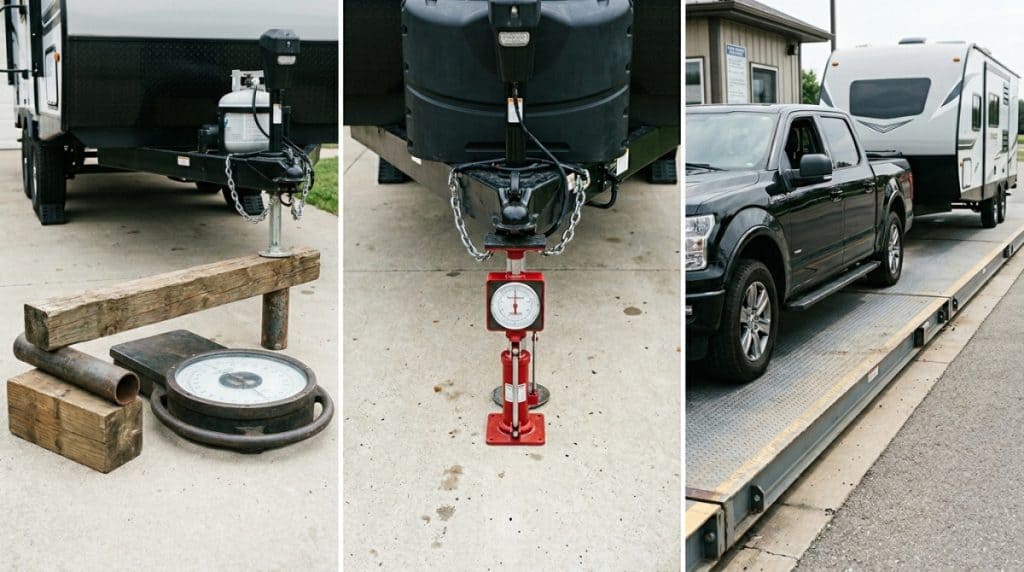
If you want the real number, you need to measure it with the trailer loaded the way you actually tow it.
That means:
- propane
- batteries
- regular trip gear
- tools
- water, if you tow with it
- anything added after the trailer left the factory
After that, here are three real-world ways to check it.
Option A: Bathroom scale at home
This is the cheapest way to get a real number without buying a dedicated tongue weight tool.
Most bathroom scales top out around 300 to 400 pounds, and many trailer tongue weights are higher than that. So the trick is to use a beam and leverage so the scale only reads a fraction of the real load.
Here is the simple driveway method:
- Park the loaded trailer on level ground and chock the wheels.
- Lay a sturdy beam on the ground where the tongue jack will sit. A solid 2×4 at least 3 feet long works well.
- Put a brick or block under one end of the beam to act as the pivot, and a bathroom scale under the other end.
- Set a short pipe or round steel bar on top of the brick and another on top of the scale so the beam rocks cleanly on each.
- Position things so the trailer’s coupler presses down on the beam 1 foot from the brick, and the scale sits 3 feet from the brick total.
- Lower the trailer jack until the coupler rests on the beam and the trailer’s full tongue load is on it.
- Read the scale, then multiply by 3. That gives you your approximate tongue weight.
So if the scale reads 250 pounds, your tongue weight is about 750 pounds.
A couple of practical tips:
- keep the trailer level while doing this
- use a scrap of plywood on the scale if needed so the pipe does not damage it
- make sure the beam, block, and scale are stable before lowering the tongue onto the setup
Option B: Tongue weight scale
If you tow often, a dedicated tongue weight scale is the easiest purpose-built tool.
You place it under the coupler, lower the jack onto it, and read the number directly. No multiplier math. No beam setup. Some hitch setups even have built-in scale-style features, but a dedicated tongue weight scale is the cleanest standalone option.
This is the simplest method if you want repeatable driveway checks without messing around.
Option C: Public truck scale
A public CAT Scale gives you the most trustworthy numbers, and it shows your axle weights at the same time.
- With the trailer unhitched, pull just the tow vehicle onto the scale and weigh it. Write that number down.
- Hitch the loaded trailer back up.
- Pull forward so only the tow vehicle’s wheels are on the scale platform and the trailer’s wheels stay on the ground past it.
- Weigh again.
- The difference between the two readings is your tongue weight.
That is the whole method.
NHTSA’s guidance is that the only way to truly know your weights is to put them on a scale, and this method also helps you confirm what is happening to the tow vehicle itself at the same time.
What to do if the number is wrong
If the number is off, the first fix is usually cargo placement, not wishful thinking.
If tongue weight is too low,
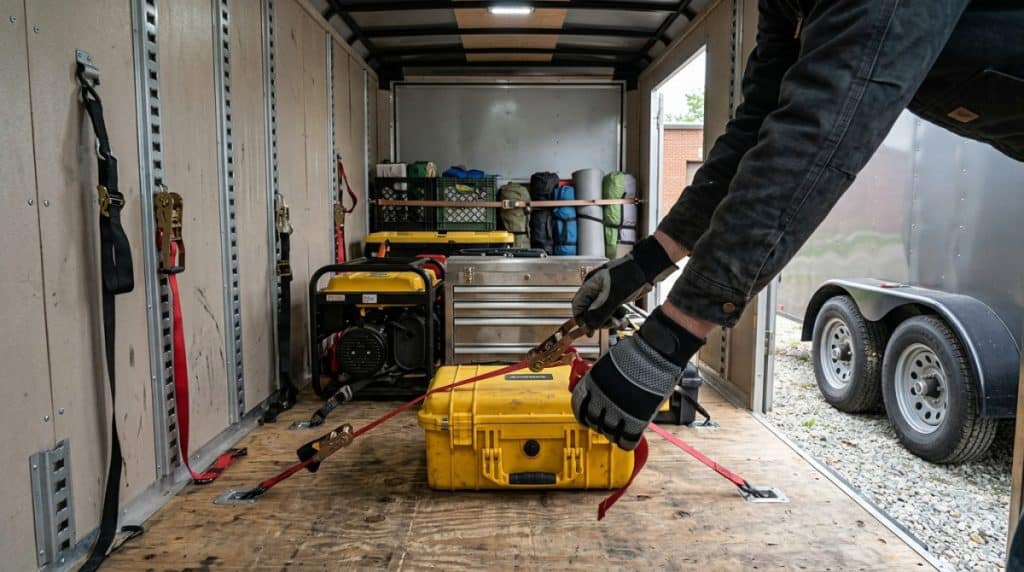
Move some weight forward in the trailer.
Keep heavy items:
- low
- secure
- balanced side to side
A simple starting point is the 60/40 rule: aim for roughly 60% of your cargo weight ahead of the trailer’s axle and 40% behind it. That balance usually gets you closer to the normal 10% to 15% tongue-weight range without blindly guessing.
Too little tongue weight usually means the load center is too far rearward, which is one big reason sway gets worse.
If tongue weight is too heavy
Move some weight rearward, but carefully.
Do not swing too far the other way and create a rear-heavy trailer. The goal is not “put everything in the back.” The goal is to bring the setup into a safer balance range without creating a new problem.
In both cases:
- reweigh it
- recheck the setup
- do not assume one cargo move fixed everything
If you load the trailer reasonably and the tongue weight still ends up wrong, then the problem may be bigger than where one cooler got placed. It may be a bad match between trailer and tow vehicle, the wrong hitch setup, or a trailer design that needs its own manufacturer guidance.
When a weight-distribution hitch helps
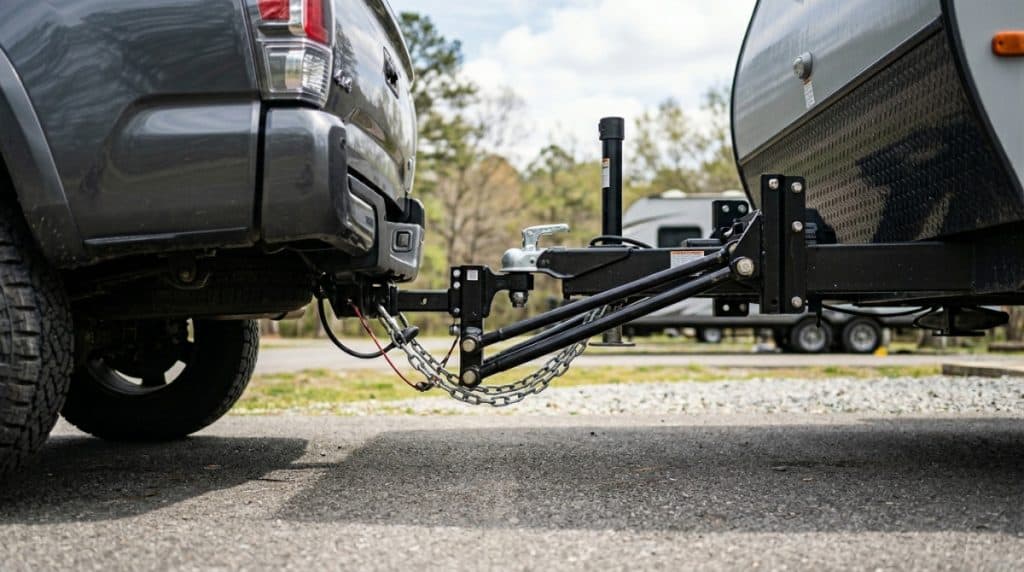
A weight-distribution hitch can absolutely help a heavier bumper-pull setup tow better.
What it does:
- helps level the rig
- shifts load more effectively across the combination
- can improve steering feel and braking compared with a badly squatted rear end
- can help a properly matched setup feel more controlled
What it does not do:
- it does not create more payload
- it does not raise your receiver or axle ratings
- it does not make an overloaded setup safe
That is the big misconception.
A weight-distribution hitch is a handling and load-management tool. It is not a magic capacity upgrade.
So yes, it can help a lot. But if the numbers are already over the ratings, the hitch does not erase that.
Mistakes people make all the time
There are a few tongue-weight mistakes that show up over and over.
Trusting dry tongue weight
Empty numbers are not the same as travel-ready numbers.
Looking only at tow rating
Tow rating matters, but payload, rear axle, receiver rating, and actual tongue weight matter just as much.
Assuming every trailer follows the same 10% to 15% rule
Most conventional bumper-pull trailers do. Some boat trailers and specialty trailers can be different.
Thinking a weight-distribution hitch creates more capacity
It does not. It helps manage load. It does not rewrite your ratings.
Loading gear wherever it fits
Cargo placement changes tongue weight. Random loading is how people accidentally build unstable setups.
Going by feel
A lot of people tow once, think “it felt okay,” and call it done. That is not the same as knowing the setup is actually right.
The blunt version is:
If you have not weighed it, you are guessing.
The bottom line
Tongue weight is one of the most important towing numbers because it affects trailer stability, steering feel, braking, and whether your tow vehicle is actually within limits.
For most conventional bumper-pull trailers, the fast rule is 10% to 15% of loaded trailer weight, then verify that number against your vehicle’s:
- payload
- max tongue weight
- hitch rating
- rear axle rating
- GVWR
If the trailer sways, the rear squats badly, or the whole setup only works on paper, stop guessing and weigh it.
FAQ
Is tongue weight the same as hitch weight?
For most conventional bumper-pull trailers, people often use those terms to mean basically the same thing. Both refer to the downward load at the hitch ball. But technically, terms like pin weight usually refer to different trailer types such as fifth-wheel or gooseneck setups.
What is a good tongue weight percentage?
For most conventional trailers, about 10% to 15% of loaded trailer weight is the normal target.
What happens if tongue weight is too low?
The trailer can become unstable and more likely to sway or fishtail, especially at speed.
What happens if tongue weight is too high?
The rear of the tow vehicle can squat, steering can feel lighter, braking balance can suffer, and you can run out of payload or rear-axle capacity faster than expected.
Does tongue weight count against payload?
Yes. Tongue weight uses part of the tow vehicle’s payload, just like passengers and cargo do.
Can a weight-distribution hitch fix bad tongue weight?
It can help a properly matched heavy setup tow better, but it does not create extra payload or make an overloaded setup safe.


