Skip to content

You get a flat, the shop quotes four tires, and your wallet starts protesting. Do you really need the full set, or can you safely buy less? Short answer: not always. On most front or rear wheel drive cars, replacing two is common, and the new pair belongs on the rear axle. On many all wheel drive vehicles, tread depths must closely match, which often means all four unless a shop can shave a new tire to match the others.
I will keep this practical. A few quick rules, then the why, then edge cases that trip people up.
Quick rules you can trust
- FWD or RWD: Replace in pairs. Mount the new pair on the rear. This keeps the car stable on wet roads if traction breaks.
- AWD or 4WD: Rolling diameters must be very close. If one tire is much newer than the others, replace all four or have the new one shaved to match. Check your owner’s manual for your model’s tolerance.
- Staggered setups: If your car uses different sizes front and rear, replace by axle at minimum. Many owners choose four to preserve balanced handling.
- Tread thresholds: Plan replacements around 4/32 inch for rain and 5/32 inch for snow, even though 2/32 inch is the legal minimum. Waiting to the bars hurts wet and snow performance more than most people expect.
- Mixing models: Avoid mixing different tire models or sizes, especially on AWD. Keep size, load rating, and type aligned.
Why new tires go on the rear

It feels backward on front wheel drive. The front steers and does the work, so shouldn’t the best tires go up there? In a panic or a heavy rain, the real danger is the rear breaking loose first. If the rear hydroplanes or loses grip before the front, the car can spin. Putting the freshest rubber on the rear delays that loss and keeps the car more predictable. You might give up a little front end bite in the dry, but you gain stability when it counts.
AWD specifics, explained simply
Think of tread depth as part of your final drive ratio. Taller tires roll a touch farther per revolution than shorter ones. On AWD, that rolling difference forces the center differential or clutch packs to slip constantly, creating heat and wear. This is why many manufacturers specify strict limits on allowable tread depth or circumference differences. If your set is outside spec, buy four, or ask a performance shop about tire shaving so a single new tire matches the three used ones.
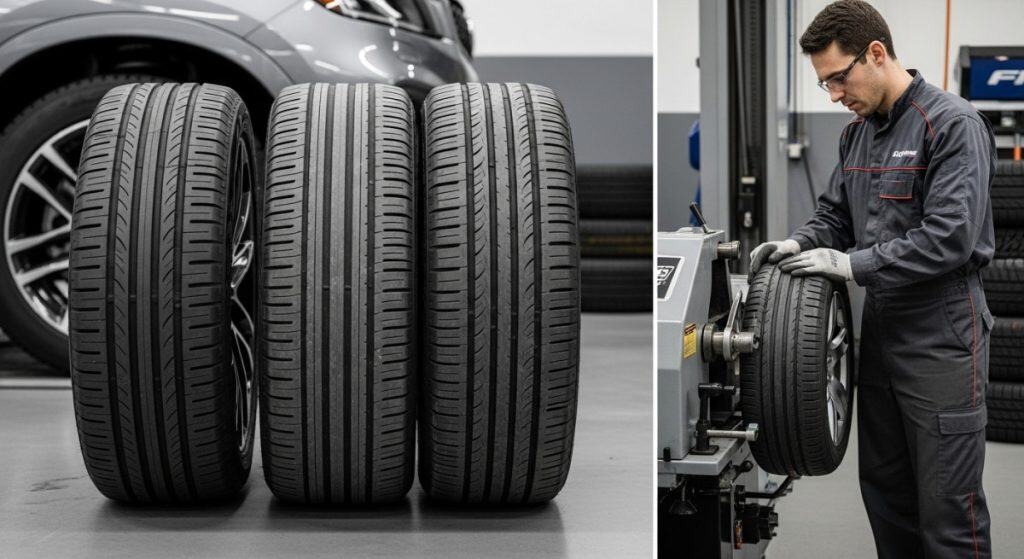
Is shaving really a thing? Yes. A technician removes a little tread from a new tire on a lathe so its depth and rolling circumference match your used pair or trio. Done properly, it is safe and far cheaper than buying an entire set you do not yet need.
A simple decision flow
- Confirm drivetrain. FWD or RWD usually means pairs. AWD often demands tighter matching.
- Measure tread depth. Use a gauge. Note the shallowest tire. If you drive in rain or snow, do not stretch to the legal minimum.
- Check your manual for AWD tolerances. If a single new tire would exceed the limit, either shave it or replace four.
- If buying two, put them on the rear. Move the better used pair to the front. Yes, even on FWD.
- Match type and size. Keep the same category and preferably the same model to avoid odd handling.
One tire only
If you ruin one nearly new tire and the others are still fresh, replacing one can work if it is the exact same model and the final tread depths are within your vehicle’s tolerance. On AWD, this is where shaving earns its keep. If the rest of the set is already well worn, consider four and be done.
Wet and winter reality check

New tires evacuate water better. Worn tires do not. Stopping distances in the wet can grow by car lengths as tread wears, which is why practical thresholds like 4/32 inch for rain and 5/32 inch for snow are worth following. I know the bars say 2/32, but that standard is about legal minimum, not everyday safety in weather.
Staggered and performance setups
If your car runs wider rears than fronts, rotations are limited, and wear can diverge quickly. Replace by axle at minimum. Many owners reset the full set when fronts and rears are both halfway worn, so the balance stays consistent and the chassis feels the same on turn in and at the limit.
Tire age also matters
Rubber ages from heat, UV, and time. Even if the tread looks fine, most manufacturers recommend replacement around six to ten years from the date code, with annual inspections starting around year five. If your tires are aging out, do not force a mixed set just to save a small amount now.
Examples that mirror real life
- FWD sedan, fronts at 3/32, rears at 5/32: Buy two, mount them on the rear, move the 5/32 pair to the front.
- AWD SUV, punctured one tire, the other three at 6/32: Replace one and shave it to 6/32, or buy four if shaving is not available.
- RWD coupe with staggered sizes, rears worn faster: Replace the rear pair now. Plan on four next cycle to reset the balance.
Practical Takeaway
You do not always need four tires. On many FWD or RWD cars, two is the safe, budget friendly move, and the new pair goes on the rear. AWD is the exception. Keep rolling diameters closely matched, or use tire shaving to keep your driveline happy. Respect practical tread thresholds for rain and snow, and do not chase the legal minimum unless you like long braking distances.