Skip to content

(Updated November 2025: added recent fee trends, dealership tactics, and updated tips on financing and gap insurance.)
Buying a car should be exciting. You’ve done your research, picked the perfect model, and maybe even test-driven it enough times that the sales rep knows you by name. It’s a big moment!
And then… the paperwork starts. Suddenly, that number you negotiated starts climbing, and climbing, and climbing some more. I remember thinking I’d nailed the price on my last car until the final documents showed a figure that somehow felt… significantly bigger. Like, thousands bigger.
What’s actually happening when those fees pile up?
- Some fees are legitimate (sales tax and registration are unavoidable)
- Others are purely profit centers (designed to pad the dealer’s bottom line)
- Many fall in a gray area (technically optional but presented as mandatory)
- All of them are worth understanding before you sign anything

Let’s break down what you’re actually paying for.
1. Documentation Fees
This one sounds official, right? Like, there’s some complex paperwork process that justifies charging you extra. Sometimes it’s $50. Sometimes it’s $500. I still don’t know why there’s such a difference between dealerships for what is essentially the same task.

What you should know:
- “Doc fees” are largely just a profit center
- They can range from $50 to $500+, depending on the dealer
- Some states cap these fees (California limits them to $85), but many don’t
- It’s one of the first places dealers make up for a low negotiated price
- In 2025, some dealers are bundling doc fees under vague “admin” or “processing” labels, especially in online sales or out-of-state transactions.
How to avoid it: Always ask about documentation fees upfront before you start negotiating the price. If it feels inflated, you can try to negotiate it down or ask for a reduction elsewhere to offset it. Some dealers won’t budge on the doc fee itself, but might be flexible on the vehicle price to compensate.
2. Dealer Prep Fees
This one always confuses me. The car was manufactured in a factory, shipped to the dealer, and… now I’m paying extra for them to “prepare” it? What exactly needs preparing?

What dealer prep actually includes:
- Removing plastic covers from seats and exterior
- Basic washing and detailing
- Checking fluid levels
- Sometimes a quick inspection
- Lately, some dealers are rolling this into packages labeled “delivery inspection” or “dealer-installed accessories,” so be sure to ask for a breakdown.
That’s it. Basic stuff that’s, well, just part of selling a car. Yet some dealers charge hundreds for these simple tasks.
How to avoid it: Politely question this fee. Ask specifically what “preparation” includes and why it isn’t just part of doing business. Many dealers will remove it if challenged because they know it’s a bit questionable.
3. Destination Charges
Now here’s where things get tricky. Destination charges actually are legitimate. Manufacturers do ship cars to dealerships, and someone has to pay for that.
What to watch for:
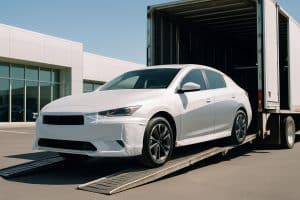
- Typically ranges from $900 to $1,200
- Set by the manufacturer, not the dealership
- Sometimes, it is already included in the advertised price
- Occasionally listed twice — once as “freight” and again as a hidden line item like “delivery logistics”
- Non-negotiable in most cases
How to avoid it: You probably can’t avoid paying this one, but you can make sure you’re not being charged twice. Ask if the advertised price includes the destination charge, and check all paperwork carefully.
4. VIN Etching
VIN etching is when they etch your Vehicle Identification Number onto your windows as a theft deterrent. It’s not a bad security measure, honestly. The issue is the pricing.
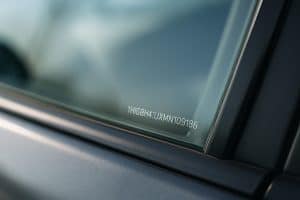
The pricing reality:
- Dealers typically charge: $200 to $400
- DIY kit from Amazon: ~$25
- Some insurance companies: Free as a service
- Value to the dealer: Huge profit margin
I once saw it itemized on a contract after I’d specifically said no. Always double-check every line, even if you think you’ve declined something.
How to avoid it: Simply decline it. If you really want VIN etching, you can get it done later for much less. Or check with your insurance company; some offer it for free.
5. Extended Warranties
When you’re signing everything, an extended warranty sounds pretty reassuring. “Complete coverage for another five years? Peace of mind? Where do I sign?”
What they don’t tell you:
- Dealership markup is often 100% or more
- Many warranties have surprising exclusions
- Most people never use the full value of what they pay
- You can buy the exact same warranty later (often cheaper)
- Some warranties can be canceled for a prorated refund
The reality is complicated. Some people genuinely find value in extended warranties. Others pay thousands and never use them.
How to avoid it: You don’t have to decide on the spot. You can purchase an extended warranty later, often for much less, through the manufacturer directly or a third party. Take your time with this decision rather than making it under pressure.
Starting in 2025, many manufacturers offer extended warranties directly online, which makes comparing dealer prices even easier. Take your time and shop around.
6. Market Adjustment Fees
This one’s particularly frustrating. When a car is in high demand, dealers sometimes add a “market adjustment” fee, basically charging extra because they can.
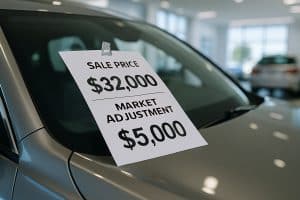
What to know about these markups:
- Can range from $2,000 to $10,000+ for popular models
- Completely arbitrary pricing based on demand
- Not set by manufacturers
- Often negotiable (despite what they tell you)
- Pure profit for the dealership
- While these spiked during the COVID-era shortages, some dealers are still adding them in 2025, especially for EVs and hybrids. Watch for “limited availability” pricing or “premium package” tricks.
Part of me gets it; supply and demand and all that. But it still feels bad when you’re the one paying thousands extra for… nothing tangible.
How to avoid it: Shop around at different dealerships, or wait if possible. These fees tend to disappear when demand normalizes. Or look for less popular colors or configurations that might not carry the markup.
7. Advertising Fees
This one’s a head-scratcher. Some dealers charge you a fee to cover their advertising costs. Think about that. You’re paying them to advertise to you and others. It’s like a restaurant charging you for their billboard that convinced you to eat there.

The breakdown:
- Typically ranges from $200 to $1,000
- Often presented as “mandatory” (it’s not)
- Sometimes listed as “regional advertising fee”
- Purely covers the dealer’s marketing expenses
- Has nothing to do with your specific car
How to avoid it: While you might not get the fee removed, you can certainly factor it into your price negotiations. If they won’t budge on removing the advertising fee, ask for a discount elsewhere.
8. Loan Origination Fees
If you’re financing through the dealership, watch out for loan origination fees or processing charges. These are essentially fees for creating your loan, which is weird considering the dealer is already making money on the financing through interest rate markup.
What you should know:
- Usually ranges from $100 to $500
- Already built into loans from banks/credit unions
- Double-dipping, since dealers already profit from interest rate markups
- Often hidden in the fine print
- Makes the actual APR higher than advertised
How to avoid it: Get pre-approved for financing from your bank or credit union before shopping. This gives you leverage and a point of comparison. If the dealer wants your business, they might match or beat your pre-approved rate without the extra fees.
9. Credit Insurance
Dealers may offer (or sometimes quietly add) insurance that covers your loan payments if you become disabled, lose your job, or pass away. It sounds responsible, but there’s more to it.

Types you might encounter:
- Credit life insurance (pays off the loan if you die)
- Credit disability insurance (covers payments if you’re disabled)
- Involuntary unemployment insurance (covers if you lose your job)
- All typically marked up 100 to 300% over what you’d pay elsewhere
How to avoid it:
- Always check your contract line by line
- If you want this protection, check with your regular insurance provider first
- Consider that your existing life/disability policies may already cover this
- Ask specifically: “Is any credit insurance included in this paperwork?”
10. Gap Insurance
Gap insurance covers the difference (or “gap”) between what you owe on your car loan and what your car is worth if it gets totaled. Since new cars depreciate quickly, this can be valuable protection, especially if you made a small down payment.

Comparing the costs:
- Dealer price: Often $700 to $1,200 in 2025, especially when bundled into monthly payments
- Auto insurance: Often $20 to $30 per year as an add-on
- Credit unions: Sometimes offer it for $200 to $300 flat fee
- Some leases: Already include it (check your contract!)
I almost bought it once at the dealership… then realized my regular car insurance already offered it cheaper. Saved about $400 with a five-minute phone call.
When gap insurance makes sense:
- You made a very small down payment (less than 20%)
- You have a loan term longer than 60 months
- You’re buying a car that depreciates quickly
- You’re rolling negative equity from a previous car loan
How to avoid the markup: Check with your auto insurance provider before agreeing to the dealership’s terms. Many offer gap coverage as an inexpensive add-on to your regular policy.
11. Optional Add-Ons (Rustproofing, Fabric Protection, etc.)
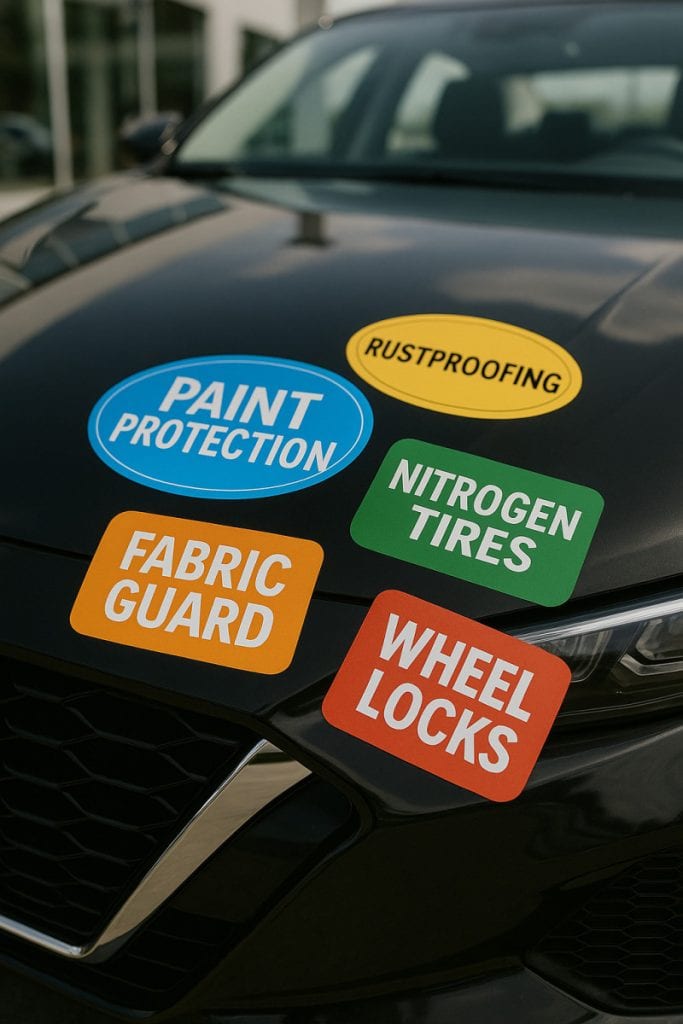
The finance office is where dealers make their real money, and they’ll often pitch you various protection packages. Paint protection! Fabric guard! Rustproofing! Nitrogen in your tires!
Common add-ons and the reality:
- Paint protection: $300 to 800 at dealer vs. $50 to 150 at detail shop
- Fabric protection: $200 to 400 at the dealer vs. a $10 can of Scotchgard
- Rustproofing: $400 to 1200 at dealer (most new cars already have factory rustproofing)
- Nitrogen tire fill: $100 to 200 at dealer vs. $5 to 10 at tire shops (or free at some)
- Wheel locks: $80 to 150 at dealer vs. $20 to 40 at auto parts store
In the moment, they seem reasonable (“only a few hundred dollars more!”). But most new cars already come with excellent paint and rust protection from the factory, and the markup on these services is often substantial.
How to avoid it: Just say no. If you want any of these services later, you can get them for less elsewhere. And some, like nitrogen-filled tires, offer minimal real-world benefit anyway.
What’s New in 2025 Car Buying Fees?
Dealerships are still finding ways to squeeze in extra fees, but the tricks are shifting. Post-COVID inventory has mostly recovered, yet many dealers continue charging “market adjustments” — especially on high-demand hybrids and EVs. Some brands are also bundling dealer-installed accessories that you can’t opt out of, like VIN etching or branded floor mats.
Online sales are more common now, and with them come new fee labels like “online convenience fee” or “third-party documentation charge.” These are often just renamed versions of old tricks, but they can slip by if you’re not paying attention.
Gap insurance and extended warranties are both easier to compare now, thanks to direct-to-consumer platforms. That means less pressure to buy on the spot and more chances to save if you take a day to shop around.
The bottom line? Car buying in 2025 is still negotiable. You just have to know what’s changed, ask questions, and take your time before signing.
Final Thoughts
Not every fee is a scam; some are legitimate costs of doing business. But knowing what’s out there gives you power when negotiating. The dealership is counting on you being tired, confused, or just eager to drive away in your new car.
Quick tips to remember:
- Always ask, “What does this fee cover exactly?”
- Request an itemized breakdown of all charges
- Be willing to walk away (your strongest negotiating tactic)
- Focus on the total cost, not just the monthly payment
- Take your time; rushing leads to expensive mistakes
- Bring a calculator (or use your phone) to check their math
You don’t have to memorize every trick. Just asking questions and reading carefully can save you hundreds, sometimes thousands. Don’t be afraid to say, “I need to think about this” or “Can you explain this fee?”
Despite all these potential pitfalls, buying a car can still be a great experience when you know what to watch for. Go in prepared, be willing to walk away, and focus on the total cost, not just the monthly payment. You’ve got this.