 Skip to content


It’s a really bad spot to be in. Your car suddenly needs a repair that could cost thousands of dollars, and now you’re trying to decide whether to fix it, replace it, or somehow get rid of it without making an expensive mistake.
If you’re panicking a little, I get it. Start with the numbers and the actual condition of the car. You do not have to make the whole decision from one repair quote.
Quick Answer:
First, confirm exactly what your car needs and what the repair will realistically cost. Then compare repairing and continuing to own your current car with obtaining and owning a suitable replacement over the same practical period. Your car’s value matters, but repair cost exceeding that value is not an automatic reason to replace it. Reliability, upcoming repairs, downtime, cash available today, replacement costs, financing, and what you can actually sell or trade the current car for all matter too. If you decide to move on, get real as-is offers and resolve any loan, lien, title, and state transfer requirements before handing over the vehicle.
The goal is not to squeeze every last mile out of a car no matter what.
It is also not to throw away a repairable car because one bill looks scary.
The goal is to figure out which option leaves you with dependable transportation at a cost you can realistically handle.
What “Not Worth Fixing” Actually Means
People use phrases like “not worth fixing,” “unrepairable car,” and “totaled” as if they all mean the same thing.
They do not.
Economically Not Worth Fixing
This is a personal financial decision.
You decide that the repair cost, future repair risk, downtime, or reliability no longer makes sense compared with the alternatives available to you.
The car may still be perfectly repairable.
You have simply decided that you no longer want to put the required money or risk into it.
Technically or Practically Unrepairable
This is different.
A qualified repairer may determine that there is no practical repair path because of the vehicle’s condition, severe structural damage, parts availability, extensive corrosion, or another limitation.
That is a technical or practical repairability issue, not just a question of whether the bill feels too high.
Unsafe to Return to Service
A vehicle can also be repairable but currently unsafe.
If the underlying problem affects safe operation, the car should not return to normal driving until that problem has been repaired correctly.
That does not automatically mean the vehicle should be scrapped.
Insurance Total Loss or Salvage Classification
An insurance total loss is another separate issue.
Insurers make total-loss decisions under their policies and applicable state rules. Salvage, rebuilt, junk, and nonrepairable title classifications can also have state-specific requirements and restrictions.
So when someone says, “My car isn’t worth fixing,” make sure you know which problem you are actually dealing with.
For most people reading this article, the question is economic:
Does repairing this car still make more sense than the replacement I could realistically get?
First, Confirm What the Car Actually Needs
Before doing any financial comparison, make sure the repair number is real.
Get an Itemized Repair Estimate

Ask the shop what actually failed and what the proposed repair includes.
You want to understand:
- what component or system failed
- what evidence supports the diagnosis
- what parts and labor are required now
- whether additional problems may be discovered after disassembly
- whether anything else major is already known to need attention soon
That last point matters.
A $3,000 repair means something very different on a vehicle that is otherwise in excellent condition than it does on one that also needs another $4,000 of known work in the near future.
Consider Another Opinion
For a large repair or a diagnosis with significant uncertainty, getting another qualified opinion can make sense.
That does not mean you automatically choose the lowest estimate.
Two shops may quote different repair scopes, parts, labor, or approaches.
The useful question is whether the diagnosis and repair plan make sense, not simply who gives you the smallest number.
Before paying for another opinion or moving the car elsewhere, ask whether any diagnostic, teardown or reassembly, storage, or towing charges apply in your situation. Knowing those costs up front can prevent the second opinion from creating another surprise.
Repair This Car or Replace It?
This is where comparing the repair bill with the car’s market value by itself falls short.
Comparing the repair bill with the car’s market value is useful, but it is not enough.
A $5,000 repair on a $4,000 car can look ridiculous if you stop the analysis there.
But what if that $5,000 leaves you with a vehicle you already know, while every suitable replacement available to you costs significantly more once taxes, registration, financing, immediate maintenance, and other ownership costs are included?
Now the decision is different.
The better comparison is:
What will it realistically cost to repair and continue owning this vehicle?
versus:
What will it realistically cost to obtain and own a suitable replacement?
Use the Same Time Period for Both Choices
Pick a practical forward-looking period that fits the decision you are making.
There is no single number of months or years that works for everyone.
Maybe you realistically want another couple of years from the current car. Maybe your replacement would also be something you expect to keep for that period or longer.
Whatever window you choose, use the same comparison period for both choices.
Do not compare one year of current-car expenses with five years of replacement-car costs.
That makes the numbers look precise while comparing two different things.
Here is a simple hypothetical. Say your paid-off car needs a $4,000 repair, and you expect another $1,000 of known work during the next two years. Keeping it would mean about $5,000 of known repair and maintenance spending over that period.
Now say a suitable replacement costs $9,000 out the door, and you can actually sell your current car as-is for $1,500. That leaves about $7,500 of replacement purchase cost after applying those proceeds.
That does not prove the current car is cheaper to own overall. A full two-year comparison still has to consider future maintenance and repairs, insurance differences, financing if any, and what each vehicle may be worth at the end. The example simply shows why you should use the same period and subtract real as-is proceeds when comparing the cash required by each path.
What Numbers to Gather
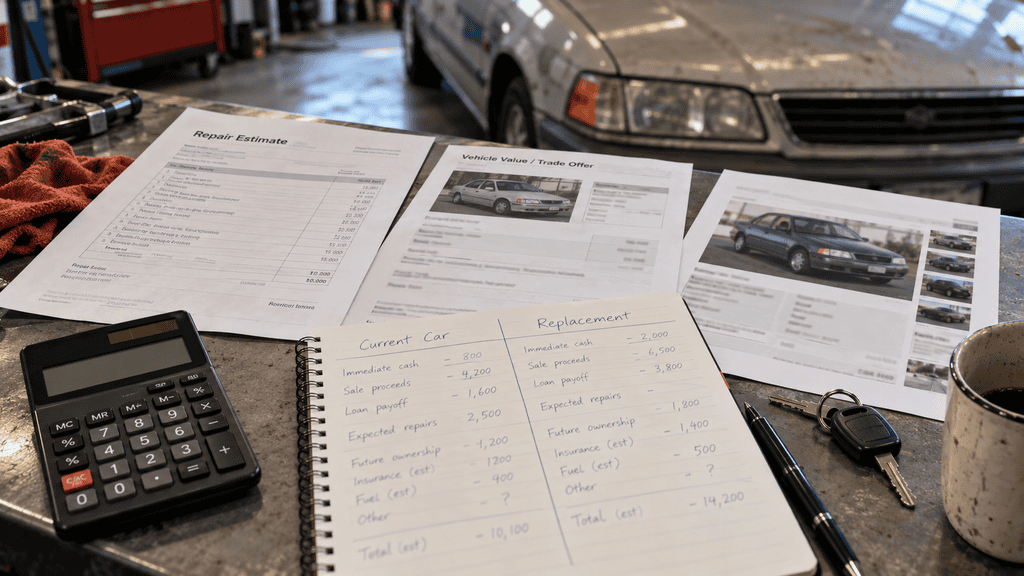
You do not need a complicated spreadsheet to start.
You do need the right numbers.
Factor: What to Compare
- Current repair: Confirmed repair cost, uncertainty, and what the repair actually restores
- Rest of current car: Known upcoming maintenance, additional repairs, damage, corrosion, and likely reliability
- Replacement: Realistic out-the-door cost and condition of a suitable alternative
- Time period: The same forward-looking ownership period for both choices
- Cash needed now: Current repair cash versus replacement down payment or purchase amount, fees, inspection, immediate work, and any negative-equity cash requirement
- Ongoing costs: Financing, expected maintenance, known repairs, insurance differences where material, and other ownership costs
- Current-car proceeds: Actual realistic as-is sale or trade proceeds if you replace the car
- Loan/equity: Lender payoff compared with the actual amount someone will pay for the vehicle
- Reliability/downtime: Breakdowns, towing, rental or alternate transportation, missed work, and predictability
- Safety/legal status: Whether the current vehicle can realistically be restored to safe and legal use
Start With Your Current Car’s Value
A valuation service such as Kelley Blue Book can give you a useful baseline.
Just remember that a value estimate is not a guaranteed check someone will hand you.
Private-party and trade-in values can differ, and mileage, condition, configuration, and your local market matter.
This becomes even more important when the car is damaged or not running.
For a seriously broken car, actual as-is offers from buyers can sometimes be more useful than the theoretical value of the same model in normal running condition.
If you own the car outright, the net amount you actually receive from selling or trading it can reduce the amount of cash or financing you need for the replacement. If you still owe money, calculate the lender payoff and your equity before treating any of the offer as replacement money.
Price a Replacement You Would Actually Buy
Do not compare your repair bill with an imaginary replacement.
Look at vehicles that genuinely meet your transportation needs in your local market.
You do not necessarily need a newer or more expensive car.
A cheaper replacement can be completely reasonable if all you need is dependable transportation.
But include more than the advertised price.
Depending on the purchase, replacement costs may include:
- taxes
- registration
- applicable transaction fees
- financing cost
- a pre-purchase inspection
- immediate maintenance
- known repairs
- insurance differences where material
A used replacement is not automatically problem-free just because it costs more than your broken car.
A vehicle-history report is useful, but it does not replace an independent mechanical inspection.
Separate Cash Needed Today From Longer-Term Cost
This distinction is important.
One option can be cheaper over the next few years while requiring significantly more cash today.
For your current car, the immediate cash requirement might include:
- the current repair
- other work that has to be done at the same time
- transportation while the vehicle is unavailable
For a replacement, immediate cash might include:
- down payment or cash purchase amount
- taxes and registration
- transaction fees
- pre-purchase inspection
- immediate maintenance or repairs
- negative equity that needs to be paid in cash
Then look separately at ongoing costs over your chosen comparison period.
If you still have a loan on the current car, those scheduled payments remain part of your cash-flow picture if you keep it. Do not add the entire payoff balance to the repair bill, but do not treat the remaining payments as if they disappear either.
If you finance the replacement, do not count the full purchase price and then add the full loan payments as a second cost. The loan payments include repayment of the financed principal. Count the acquisition cost once and account separately for the cost of borrowing, or compare the loan cash flows instead, but do not use both methods for the same dollars.
That can include financing, maintenance, likely repairs, insurance differences, and reliability.
Do not force those two questions into one number.
Can I afford this today? and Which option costs me less over time? are both legitimate questions.
If You Still Owe Money on the Car
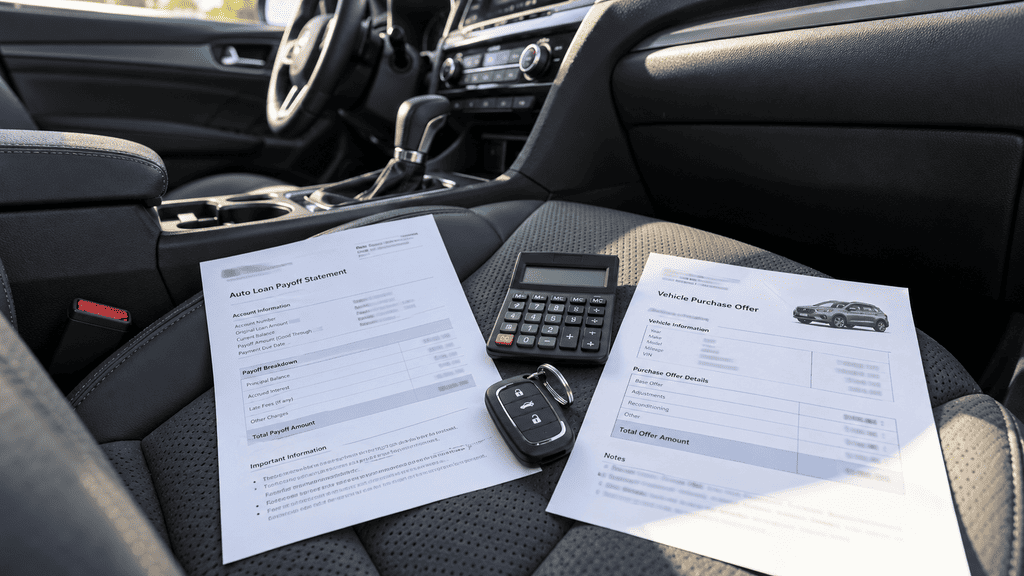
A loan adds another layer, but it does not change the basic repair diagnosis.
Start by asking your lender for the vehicle’s current payoff amount.
That number can differ from the balance shown on your latest statement.
Then get an actual sale or trade offer for the car.
Positive Equity
If the vehicle can be sold or traded for more than the payoff amount, the difference is positive equity.
For example, if your actual proceeds exceed what is required to satisfy the lender, the remaining amount can help fund the replacement.
Negative Equity
If the payoff is higher than what someone will actually pay for the car, the difference is negative equity.
That shortfall does not disappear because you trade the car.
It still has to be satisfied.
Depending on the transaction, it may be paid in cash or, where permitted, rolled into the replacement financing.
Rolling negative equity into another loan increases the amount you finance and can increase the overall borrowing cost.
That makes negative equity an important constraint on replacement.
It does not automatically mean you should repair the current car.
It also does not automatically mean you should replace it.
Do Not Count the Same Debt Twice
This is where repair-versus-replace math can get messy.
If you use the current car’s gross sale proceeds in the replacement calculation, account for the lender payoff before treating the remaining amount as money available toward another car.
Do not subtract the full proceeds and then subtract the same equity again.
Likewise, do not add the entire outstanding loan balance as a replacement expense and then add the negative-equity shortfall a second time.
Use the equity calculation once.
If the shortfall is rolled into a new loan, it becomes part of the amount financed. Consider the financing cost that results without adding the same shortfall again as a separate expense.
And if you keep the current car, do not simply add the entire existing loan balance to the repair bill and call that the “cost of repairing.”
The debt already exists.
The new repair spending is a separate decision.
Repair to Keep vs. Repair Before Selling
These are two different financial questions.
Repair and Keep
If your plan is to repair the car and continue driving it, compare:
- repair cost
- known upcoming work
- expected reliability afterward
- likely downtime
- ongoing ownership costs
against the cost and condition of the replacement you could realistically obtain.
A repair can make sense even when the bill is large relative to the car’s book value if the repair restores useful, dependable transportation for less than your realistic alternative.
It can also be a bad decision even when the repair costs less than the car is worth if the vehicle still has multiple expensive problems waiting behind it.
Repair Before Selling
Now the question is different.
Ask whether repairing the vehicle actually increases your realistic net proceeds enough to justify the repair, time, and transaction risk.
A simple way to think about it is:
realistic repaired sale proceeds
minus repair cost
minus added time or transaction cost
compared with:
realistic as-is proceeds
Do not assume the car’s theoretical fully functional retail value is what you will actually receive after fixing it.
Get realistic numbers.
If the vehicle has a loan, the same lender payoff generally affects both sale paths, so do not count that payoff twice when comparing repair-then-sell against selling as-is.
Reliability, Downtime, and Other Costs the Math Misses
Not every cost appears on a repair invoice.
Reliability has real value.
If you find yourself wondering every morning whether the car is actually going to start, that uncertainty matters too.
If a vehicle repeatedly leaves you stranded, requires towing, makes you miss work, disrupts family responsibilities, or prevents you from trusting it on a road trip, that matters.
You may reasonably decide to spend more overall for transportation that is more predictable.
The opposite can also be true.
A car that needs one expensive repair but has otherwise been dependable may still make sense to keep.
This is why I would not reduce the whole question to:
repair bill versus Kelley Blue Book value.
Your transportation has a job to do.
The decision should consider how confidently the car can keep doing it after the repair.
Can DIY or Used OEM Parts Change the Decision?

Sometimes they can.
Personally, one of the things I look at is whether part of the repair falls within what I can realistically do myself.
I have also sourced OEM replacement parts from junkyards when that allowed me to get an appropriate part for less than buying a comparable new or shop-supplied component.
I wrote more about that process in my guide to locating hard-to-find used OEM parts.
That does not mean every expensive repair becomes a cheap weekend project.
DIY changes the economics only when the job fits your:
- skill
- tools
- workspace
- available time
- ability to complete the repair safely and correctly
The same applies to used OEM parts.
They can be a smart cost-saving option for the right component, but condition, compatibility, availability, and suitability matter.
If you are deciding whether a repair has moved beyond what you should tackle yourself, MotorHills also has a guide on when to go to a mechanic and when to fix things yourself.
My Personal Repair-Budget Approach
I also use a personal repair budget.
This is my own budgeting rule, not an industry standard and not a formula that says when your car must be scrapped.
I look at the value of my car and decide how much I am personally willing to spend on repairs and upkeep over a year before I start questioning whether I want to continue owning it.
For example, if my car is worth around $10,000, I might personally decide that roughly $5,000 in repair spending during that year is where I have had enough.
Again, that is my stopping threshold.
You might choose something completely different.
The more important idea is to pay attention when repairs start piling up and changing what the vehicle costs you to own.
Do Not Let Past Repairs Make the Next Decision for You
There is also a trap here.
Money you already spent does not automatically justify another repair.
It also does not automatically mean you should get rid of the car.
If you spent thousands maintaining the car over several years, that money paid for the transportation you received during those years.
For the decision in front of you now, ask:
What will the next dollars I spend actually buy me?
Will they restore a dependable vehicle?
Or are they likely to lead into another round of expensive problems?
That is more useful than adding every repair receipt the car has ever had and comparing the total with today’s vehicle value.
Car Problems That Can Make Repair Hard to Justify
There is no honest universal list of repairs that automatically means a car is not worth fixing.
A major engine repair might make no sense on one car and be completely reasonable on another.
The same applies to transmissions, hybrid components, collision repairs, electrical problems, and other expensive jobs.
Instead, look for combinations of problems.
Repair becomes harder to justify when:
- the current repair is expensive and the final cost is still uncertain
- several other major systems also need attention
- the vehicle has been repeatedly breaking down
- serious corrosion, structural damage, or unresolved safety problems remain
- the repair is unlikely to restore much dependable use
- the parts or practical repair path are difficult or unavailable
- a suitable replacement is realistically obtainable for similar or lower overall cost
- downtime is becoming a serious problem for work or daily transportation
One major repair is not automatically the end.
A vehicle that is failing in several expensive ways at the same time is a different decision.
If the Car Was Declared a Total Loss
An insurance total loss should not be treated as another name for “I personally do not think this repair is worth the money.”
Insurers determine total losses under their policies and applicable state rules.
If you still owe money on a totaled car, compare the insurance settlement with your lender payoff. If you already purchased GAP coverage or another GAP product, check its terms to see whether it covers some or all of any remaining shortfall. GAP is intended for certain theft or total-loss loan shortfalls, not ordinary mechanical repairs, and its eligibility and coverage limits depend on the product.
Depending on the circumstances and jurisdiction, keeping and repairing a totaled vehicle may sometimes be possible.
But that does not mean there is nothing legally stopping you from simply fixing it and driving away.
Title status, salvage requirements, lienholder interests, inspections, registration rules, and road-use restrictions can apply.
States also use different classifications.
A salvage vehicle and a vehicle classified as nonrepairable may not have the same future.
Some state classifications can prevent a vehicle from later being titled or registered for normal road use.
So if an insurer has declared the car a total loss and you are thinking about keeping it, check your insurer, lender if applicable, and your state’s actual title and registration requirements before spending money on the rebuild.
Do not assume another state’s process applies to you.
What to Do When You Decide Not to Fix It

If you run the numbers and decide that repairing the car no longer makes sense for you, the vehicle may still have value.
The best option depends on its condition, title status, loan situation, and what buyers will actually offer.
Get real offers where practical rather than assuming one route always pays the most.
Sell It to a Private Buyer
A private buyer may be interested in the car as:
- a repairable vehicle
- a project
- a source of parts
- a vehicle they can repair more cheaply than you can
Be accurate about the condition.
If you know about a major material problem, do not misrepresent it.
You can also provide the repair estimate if that helps the buyer understand what you have already learned.
But do not rely on a universal statement such as “Lemon Law requires every private seller in the U.S. to disclose everything.”
Private-sale requirements vary by state.
Your state may have requirements involving titles, odometer statements, title brands, known defects, bills of sale, damage disclosures, or other transfer information.
Likewise, calling a sale “as is” does not automatically eliminate every obligation that may apply under state law.
Check the appropriate DMV or state consumer guidance for the transaction.
Sell or Trade It to a Dealership
A dealership can be convenient, especially if you are purchasing the replacement there.
The dealer may offer to take the existing vehicle as a trade even with mechanical problems.
Do not assume the dealer will always pay less than a private buyer.
Compare the actual net offers available to you.
MotorHills has a separate guide explaining how a car trade-in works if you want to go deeper into that process.
If the vehicle is financed, make sure the trade paperwork correctly accounts for your lender payoff and any positive or negative equity.
Get an Offer From an Online Car Buyer
Online buyers give you another way to get a real as-is offer without listing the vehicle yourself.
Carvana is one example, but its published requirements include a working odometer and a vehicle it can safely drive, so it is not an option for every damaged or nonrunning car.
Other online buyers have their own eligibility rules, so check the buyer’s current requirements before relying on an offer.
The larger point is not that you should use one specific company. An online-buyer quote is simply another real number to compare with private, dealer, and salvage offers.
Sell It to a Junkyard, Salvage Buyer, or Scrapyard
For a badly damaged, nonrunning, or very low-value vehicle, a junkyard or salvage buyer may still be interested when other buyers are not.
Do not assume every company provides free towing or pays the same way.
Get more than one offer when practical and ask each buyer:
- What is the net amount I will receive?
- Does pickup or towing cost extra?
- What title or ownership documents do you need?
- How and when will I be paid?
- Are there any fees or conditions that reduce the quoted amount?
The highest headline offer is not necessarily the best offer if fees or towing charges come out of it.
Part Out the Car Yourself
You can also consider selling usable parts individually.
For some vehicles, this may generate higher gross proceeds than selling the vehicle whole.
That does not guarantee you will come out ahead.
Parting out a vehicle takes:
- mechanical skill
- tools
- workspace
- storage
- time
- buyers for individual parts
- removal and possibly shipping
- eventual disposal of the remaining shell
You also need to handle the remaining title or disposal requirements correctly.
Compare the likely net return and effort with an actual offer for the complete car.
If you would spend months storing and dismantling a vehicle to make only a little more than a salvage buyer already offered, the whole-car sale may be the better deal for you.
Before You Hand Over the Car
Whatever route you choose, slow down before the final transfer.
Confirm the details that apply to your situation:
- Who currently holds the title?
- Is there still a lien?
- What is the current lender payoff?
- Does the vehicle have a salvage or other title brand?
- What signatures or disclosures does your state require?
- What is the actual agreed sale amount?
- Are there towing or pickup charges?
- How and when will you be paid?
- Does your state require a notice of sale, release of liability, plate action, or another step after transfer?
If the car is financed, do not assume you can simply sign it over and deal with the lender later.
Financed vehicles can often be sold or traded, but the payoff and lien-release process has to be handled correctly.
Make the Next Dollar Count
A car is not automatically a bad repair simply because the repair bill exceeds its book value.
Start by confirming what is actually broken and what it will really cost to fix.
Then look at the rest of the car.
Ask what the repair is likely to restore, what else is coming, and whether you can depend on the vehicle afterward.
Compare that with a replacement you could realistically obtain, using the same time period for both options. Keep the cash you need today separate from the longer-term ownership cost, and account for whatever the current car can actually sell or trade for.
If you owe money, calculate the equity once and do not pretend the debt disappears when the car changes hands.
If you decide the car has reached the end of the road for you, that is okay.
Private buyers, dealers, online buyers, salvage yards, and parting out can all be legitimate options depending on the vehicle.
The important thing is to stop asking only, “Is this repair more than my car is worth?”
Ask the better question:
What will the next dollars I spend buy me, and which option gives me the transportation I actually need?
External Resources
- Kelley Blue Book: Vehicle value guidance, including trade-in and private-party value
- FTC: Buying a used car from a dealer, including out-the-door costs and independent inspections
- FTC: Financing or leasing a car, including total financing cost
- CFPB: Trading a vehicle that is not paid off and determining lender payoff/equity
- FTC: Auto trade-ins and negative equity
- U.S. DOJ / NMVTIS: Total-loss and salvage reporting guidance
- Texas Department of Insurance: Example of owner-retained total-loss and salvage-title requirements
- CFPB: What Is Guaranteed Asset Protection (GAP) Insurance?
- Massachusetts: Private Party Car Sales
- New York Attorney General: Used Car Lemon Law
- California DMV: Salvage, Nonrepairable, and Junk Vehicle Definitions
- Carvana: Vehicle Acceptance Requirements


Thanks for the tip about knowing when to sell your car. My car needs some transmission work. I still think it’s worth fixing, so I’ll definitely look into getting it working again.
I’m glad you found it helpful!
THanks it is good to have reassurance and to know that in fact it is a difficult decision. I have an 2013 Audi that has never given me a moment of concern but now being this age, there are approx. $4500 worth of repairs that must be done. I would buy new today but the car i am looking for will not be available for 8 months and they will not accept my car now as a trade in. I would be willing to live without the car for 8 months but they don’t want it… Just not sure how to proceed. Stressing me out like crazy. My car should be good after this money is put into it…
Repair bills can indeed sometimes be that high depending on what all is needed. If this is the dealership giving you that quote, see if there is a reputable European mechanic that specializes in Audis as they can probably do it for cheaper than what the dealership is charging. Make sure to check reviews online and ask around before trusting them with your vehicle.
If the estimate is primarily a single repair then there’s not much wiggle room, however, if the estimate for repairs is comprised of multiple things that need to be addressed, I would recommend talking with your mechanic and only getting the essential repairs done so you can at least be safe on the road and drive it for 8 months or longer. At that point, you can decide whether or not you want still to purchase that other vehicle or keep your current one.
Thankyou for this very informative article! I wanted to scrap my car memphis and I sold them with fre of cost pick up and counseling When a car is no longer worth fixing one should just get rid of it
No problem! Sometimes a cost-benefit analysis is needed whenever the much larger bills start to stack up and the vehicle is already worn out due to age, high mileage, or both.
My fiat 500 has gone through a heavy damage towards the left side of the car. The left front and left back was badly hit . The bumper, bonet, left back light are worse. Also the front looks de-alligned. Its a 2015 model and the quotes say it would us between 4500-5500 euros. Meanwhile I am scared if they would later say there are more hidden breakages then it would cost even higher. Market is also difficult , the same car if I purchase second hand now it costs 11k euros. What do you suggest? (Note : I dont have all risk insurance)
The Fiat 500 is a small car. For it to incur that much damage here in the US, some States would write that off as a total loss. If you didn’t have comprehensive insurance at the time of the accident it can be challenging to get any money from an insurance company, plus it depends on who was at fault in the accident. I’m not sure what country you live in as rules can be different there but if you have a reputable auto body shop that you trust and know they do excellent work then it might be worth repairing. Otherwise, I would suggest finding another vehicle especially if the car’s total value is 11k Euros. The quote for the repair you mentioned, I’m not sure what all that includes. It could be for repairs and parts only and not including paintwork.
You should contact a professional to see if what the cost would be to save the car. If it is woth more than it is better to sell scrap cars memphis an get cash instead.