Skip to content

Buying a car with bad credit can feel like you are getting punished for trying to keep your life moving.

You need a car to get to work and handle day to day stuff, but the moment a lender sees your score, the deal suddenly gets more expensive and way more stressful.
Here’s the good news: you can still buy a car with poor credit. People do it every day without wrecking their finances. The difference is they go in with a plan, not panic.
This guide covers what “bad credit” usually means to lenders, where you can still get financing, what to avoid, how to improve your approval odds, and how to use the loan to rebuild your credit after you buy.
Quick reality check: car payments are getting huge
Before we talk lenders, it helps to zoom out for a second.
Car payments have gotten big enough that a lot of buyers are stretching their budgets just to make the monthly number work. For example, Experian reported the average new-car payment was $742 in Q4 2024, and the average used-car payment was $525. (Experian)
Edmunds also found that in Q2 2025, 19.3% of financed new-car buyers took on $1,000+ monthly payments, and 22.4% of new-car loans were 84 months or longer. (Edmunds)
That matters for bad-credit buyers because high APR plus a long loan term is how “affordable monthly payment” turns into “expensive car for a very long time.”
So here’s the goal: get a car you can actually afford, not just one you can get approved for.
What “bad credit” means for car loans
Lenders do not treat credit like pass or fail. They think in risk buckets.

In general, once you are in the lower ranges (often under the mid to high 600s), lenders start pricing you as higher risk. That usually means higher interest rates, tighter approvals, and more conditions.
Also, your score is not the only thing they look at. A lender is usually asking questions like:
- Have you been paying bills on time lately, or are there recent late payments?
- Is your income steady, and how long have you been at your job?
- How much monthly debt do you already have compared to your income?
- Are your credit cards maxed out or close to it?
- Have you had a car loan before, and did you pay it as agreed?
That’s why two people with the same score can get totally different offers.
What gets harder when your credit is poor
Bad credit usually creates the same set of problems over and over.
First is the APR. This is the “bad credit tax,” and it can turn an affordable car into an expensive loan if you are not careful. Even in the overall market, Experian reported average rates around 6.35% for new and 11.62% for used in Q4 2024, and bad credit can land you much higher than that.
Second is the down payment. Many lenders want more money down because it lowers their risk and lowers the amount you have to borrow.
Third is the co-signer conversation. A co-signer can absolutely help you qualify, but it also puts their credit on the line. It is a serious commitment, not just a signature.
And finally, limited options can lead to more pressure. When you are stressed, it is easier to accept a deal just because it is an approval. That is where people get trapped.
Where you can actually get a loan

Traditional banks
Banks can be great for borrowers with stronger credit, but they are often stricter with lower credit applications. If your credit is very low, you might get declined unless you have strong income, stable employment, and a solid down payment.
Still worth checking your own bank if you have an established relationship there.
Credit unions
Credit unions are often a better starting point for bad credit buyers because many take a more member-focused approach. Some are more willing to look at the full situation instead of auto-rejecting based on the score alone.
If you can qualify for membership, this is one of the first places I would check.
Dealer financing
Dealer financing can be convenient because the dealer sends your application to multiple lenders and comes back with offers.
The upside is access, since dealers often work with lenders that will approve tougher credit profiles. The downside is that it can turn into rate markups, monthly payment games, or a contract packed with extras you did not plan to buy.
Dealer financing can be fine. Just make sure you are reading the full deal, not just the monthly number.
Buy Here, Pay Here dealerships
These are the “we finance everyone” lots. Approval is easier, but the cost can be brutal. Higher prices, higher rates, and faster repossession risk are common.
The biggest thing to watch here is whether your payments are reported to the major credit bureaus. If you are paying a high price to rebuild, you want your on-time payments to actually count.
Online lenders and marketplaces
Online pre-qualification can help you compare offers before you are sitting in a finance office. It can also help you set expectations so you do not get surprised by the numbers.
Just be picky. Avoid sites that feel like they exist mainly to collect your information and sell it.
Subprime auto finance companies
These are specialty lenders that approve higher-risk borrowers, often through dealerships. Rates can be high, but this can work as a bridge if you plan to refinance later after you build a clean payment history.
Pitfalls to avoid
You do not need to be paranoid, but you do need to slow down and read what you are signing.
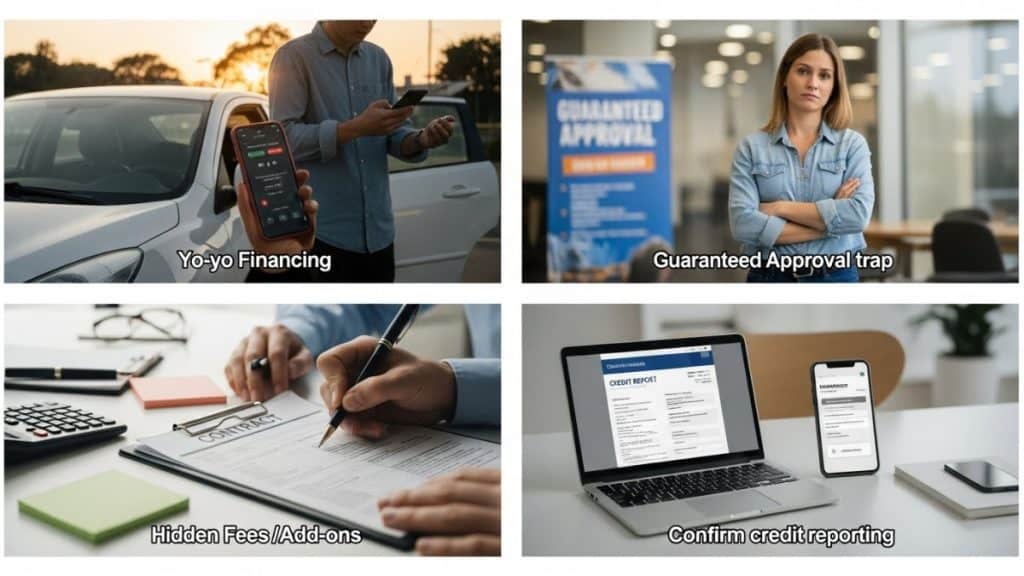
Here are the most common traps:
- Yo-yo financing (spot delivery): You take the car home, then you get a call later saying the financing changed and you need to sign a worse deal. If the financing is not fully approved and finalized, treat it like it is not done yet.
- “Guaranteed approval” promises: Usually means the deal is priced heavily in the lender’s favor.
- Hidden fees and add-ons: Products and fees quietly added into the paperwork. If you did not agree to it, question it.
- Not confirming credit reporting: If you want this loan to help your credit, make sure it is actually being reported.
How to improve your approval odds before you apply
This is where you gain control back.
Check your credit reports first
Look at your actual credit reports, not just the score. Errors happen. Old information can stick around. Accounts can be reported wrong.
If you find mistakes, dispute them through official channels.
Save for a down payment
A down payment helps in three ways. It lowers what you need to borrow, it makes a lender more comfortable approving you, and it lowers the risk of being upside down early.
Even if you cannot put down a lot, putting down something usually helps.
Consider a co-signer carefully
If a co-signer is truly available and understands the risk, it can improve approval odds and sometimes help with rate. But do not treat this as a quick fix if the payment is not comfortable for you. One missed payment can damage both of you.
Get pre-approved if you can
Pre-approval changes the whole conversation. You stop begging for approval and start comparing offers. It also helps you focus on total price instead of only the monthly payment.
Choose a realistic car and loan term
This is where people accidentally trap themselves.
If the only way the payment works is stretching the loan to a very long term at a high APR, it is usually a sign the car is too expensive for your current situation.
A reliable used car with a comfortable payment is usually the smart move until your credit improves.
What documents you’ll usually need
Most lenders will ask for a basic set of paperwork. Having it ready makes everything smoother:
- Driver’s license or valid ID
- Proof of income (pay stubs, bank statements, or tax returns if self-employed)
- Proof of residence (utility bill, lease, or similar)
- Insurance information
- Trade-in title or payoff info (if applicable)
Some subprime lenders may also ask for references or additional bank statements.
Leasing vs. buying with poor credit
Leasing usually is not easier when your credit is poor. Many lease programs want fair-to-good credit, and even if you get approved, you could face higher upfront costs and strict rules.
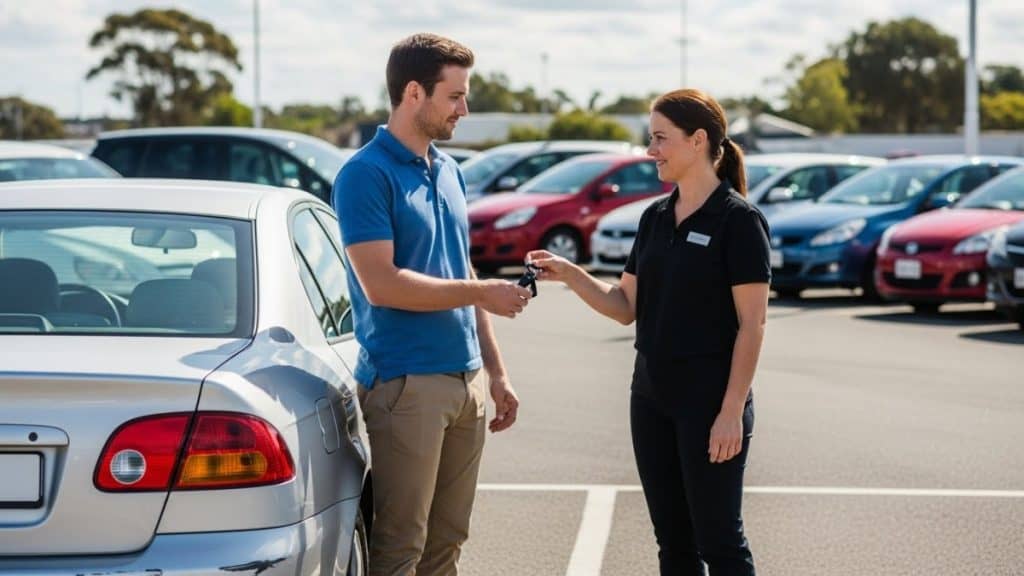
Buying is often more realistic because the loan is secured by the vehicle. If you choose a modest, reliable car, buying tends to be more forgiving and gives you a clearer path to ownership.
How to rebuild credit after you buy
This is where the loan can actually become useful.
Your goal is simple: build a clean streak of on-time payments.
A setup that makes this easier:
- Turn on autopay if you can.
- Keep a reminder a few days before the due date anyway.
- Check your credit occasionally to confirm the lender is reporting correctly.
After 6 to 12 months of clean payments, refinancing may become possible. That is often how people escape a high APR. Use the first loan to prove reliability, then shop for a better one later.
The takeaway: get the car, not the trap
Bad credit makes car buying harder, but it does not have to turn into a financial mess.
Check your reports first, shop lenders before you shop cars, and do not let anyone rush you into a contract you do not fully understand. If you keep the car choice realistic and the payment comfortable, this loan can be a stepping stone to better credit, not a long-term punishment.
External Resources
- https://www.annualcreditreport.com/index.action
- https://consumer.ftc.gov/articles/free-credit-reports
- https://www.consumerfinance.gov
- https://www.consumerfinance.gov/ask-cfpb/how-will-shopping-for-an-auto-loan-affect-my-credit-en-763
- https://www.consumerfinance.gov/ask-cfpb/what-is-a-no-credit-check-or-buy-here-pay-here-auto-loan-or-dealership-en-887
- https://mapping.ncua.gov
- https://www.nerdwallet.com/auto-loans/calculators/auto-loan-calculator
- https://www.myfico.com/credit-education